
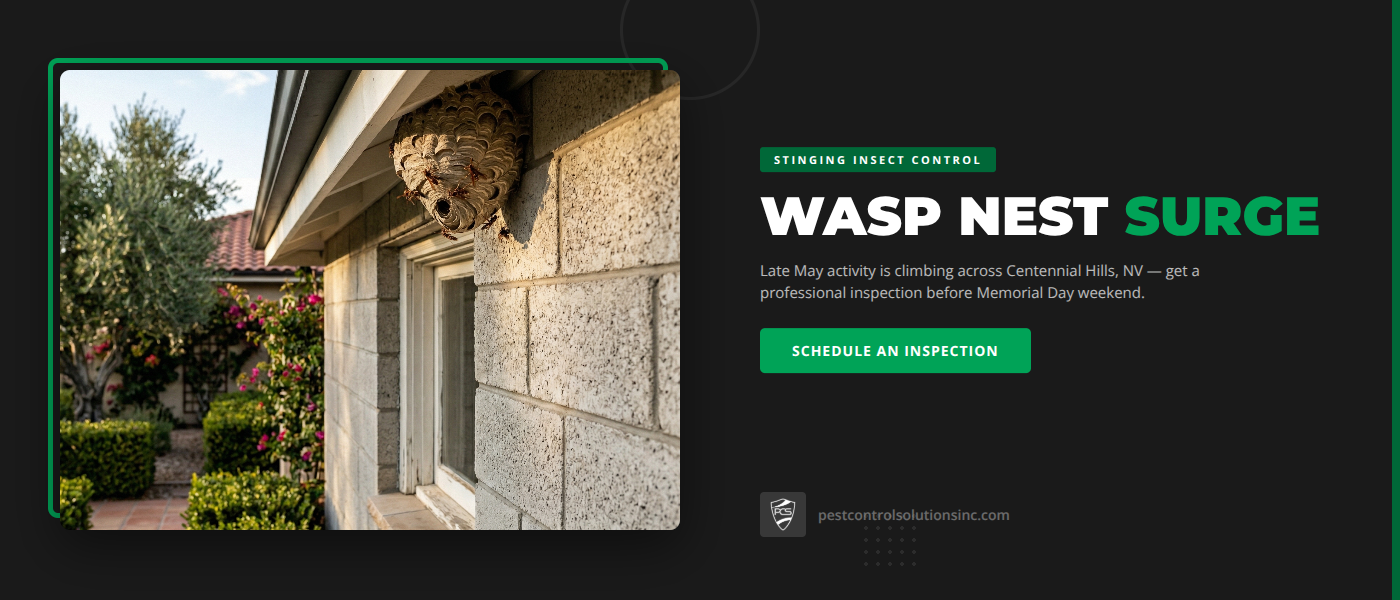
Late May is the tipping point for wasp activity across the Las Vegas Valley, and Centennial Hills feels it as sharply as any neighborhood in the northwest corridor. As daytime highs push into the triple digits and overnight lows settle comfortably in the upper 70s, paper wasps, yellow jackets, and mud daubers shift into full colony-building mode — and the homes, block walls, and yards of Centennial Hills become prime real estate. At Pest Control Solutions, we see a clear seasonal spike in wasp calls starting around Memorial Day weekend every year, and understanding why that surge happens — and what it means for your property — is the first step toward getting ahead of it before someone gets hurt.
Why Late May Triggers a Wasp Nest Surge in Centennial Hills
Centennial Hills sits at the northwestern edge of the Las Vegas metro, where master-planned communities back up against open desert terrain along the Spring Mountains foothills. That geography matters for wasp biology. Open desert provides undisturbed nesting sites, while the neighborhood's manicured yards offer exactly what growing wasp colonies need: accessible water sources, insect prey, and abundant structural nesting sites protected from the Mojave sun.
Wasp colonies typically begin with a single overwintered queen who starts building in early spring. By late May, colonies that started in March have had six to eight weeks of growth — worker populations can number in the hundreds for paper wasps, and in the thousands for yellow jacket colonies that nest underground. Those colonies are large enough to defend aggressively, which is when stinging incidents spike.
The Memorial Day timing is not coincidental. Increased human outdoor activity — backyard gatherings, pool parties, yard cleanup — brings people directly into contact with nest sites that went unnoticed all spring. A nest that was the size of a golf ball in April is now a softball-sized structure full of defensive workers. Reaching for a garden hose, grabbing patio furniture, or bumping a fence post near an established nest is enough to trigger a mass defensive response.
Centennial Hills' housing stock also plays a role. The neighborhood's stucco-on-block construction, Spanish tile rooflines, and extensive block walls create dozens of sheltered cavities per property that wasps evaluate as potential nest sites every season.
Common Stinging Insects Found Around Northwest Las Vegas Homes
Not every stinging insect in Centennial Hills is the same, and identification helps homeowners understand both the risk level and the right removal approach.
Paper wasps are the most commonly encountered species. They build open, umbrella-shaped nests from chewed plant fiber and saliva — the papery, honeycomb-looking structures most people recognize immediately. Paper wasps prefer protected vertical surfaces: the underside of eaves, the inside of block-wall caps, patio cover beams, and door frames. They are moderately defensive and will sting when the nest is approached directly, but they are generally less aggressive than yellow jackets when nesting at a distance from foot traffic.
Yellow jackets are the species most likely to produce mass stinging incidents. They nest underground or in enclosed wall voids and are far more aggressive defenders than paper wasps. A yellow jacket nest near a gate latch, hose bib, or buried irrigation valve is a serious concern, particularly with children playing nearby. Underground nests in Centennial Hills can be difficult to locate because the entrance hole is often small and partially hidden by landscape gravel.
Mud daubers are solitary wasps that construct small, tubular mud nests on walls, eaves, and inside garages. They rarely sting and pose minimal medical risk, but their nests are often confused with more aggressive species. Leaving mud dauber nests undisturbed is typically fine — they actually prey on the spiders and insects that attract other pests.
Africanized honey bees are present throughout the Las Vegas Valley and are occasionally confused with wasps. Africanized bee colonies defend a much larger territory and respond to perceived threats far more intensely than European honey bee populations. If you suspect bees rather than wasps, do not attempt any removal — contact a professional immediately. Our bee control team handles both honey bee relocation and wasp elimination throughout northwest Las Vegas.
Where Wasps Build Nests in Centennial Hills Properties
When we inspect a Centennial Hills home for wasp activity, we work through a consistent list of locations. These are the sites where we find active nests most frequently.
Roofline overhangs and soffits. The underside of Spanish tile overhangs and wood soffits provides perfect protection from sun and wind. Paper wasps particularly favor these spots, and nests here often go unnoticed until they are well established because they face away from the ground.
Block-wall caps and cavities. Centennial Hills' ubiquitous concrete block walls have hollow cavities in the upper course and capped seams. Yellow jackets regularly establish nests inside block-wall voids, accessing them through small gaps in the cap or damaged mortar. These hidden nests are among the most dangerous because homeowners lean against the wall or brush their arm along the top without realizing a colony is inside.
Irrigation valve boxes and water meter covers. The cool, enclosed space inside an irrigation valve box is highly attractive to yellow jackets seeking a protected underground-equivalent cavity. We regularly find active nests inside utility covers throughout Centennial Hills — always look before reaching into any ground-level utility box during spring and summer.
Patio cover framing and pergola beams. Open patio cover structures with exposed framing along the underside offer multiple attachment points for paper wasp nests. The nests blend visually with the wood or aluminum framing and are easy to overlook until the colony is large.
Garage door tracks and opener housings. The interior of a garage is one of the most frequently reported nest sites we encounter. Paper wasps build along the upper track of roll-up garage doors, inside the opener motor housing, and in the gap above the framed doorway. Anyone reaching above their head in a garage during summer should check first.
Barbeque grills and outdoor equipment. Grills, smokers, and outdoor storage cabinets that sit unused for weeks offer enclosed, sun-shaded harborage. Always open and visually inspect any outdoor equipment that has not been used recently before lighting or reaching inside.
Children's play equipment. Swing set cross-members, slide tubes, and the enclosed frame of playhouses are all attractive nesting locations. Inspect play equipment carefully at the start of each play session during late spring and summer months.
The Real Risks of Removing a Wasp Nest Yourself
Hardware stores stock aerosol wasp sprays with impressive-sounding range claims, and it is tempting to grab a can and deal with a visible nest on a Saturday afternoon. The problem is that DIY wasp nest removal goes wrong in ways that can produce serious medical emergencies — and the failure rate for DIY treatment goes up sharply as nest size increases.
A partial treatment that disrupts but does not eliminate a paper wasp colony causes the surviving workers to disperse and often relocate to a second nest site nearby. Worse, it can cause a defensive rally — hundreds of workers flooding out before the aerosol knockdown takes full effect, in a volume that outpaces what a consumer product can address. Yellow jacket nests are particularly dangerous to treat DIY because the underground entrance means the spray user cannot see the colony size or the emergency exit routes that workers use when the primary entrance is disrupted.
Wasp stings cause anaphylaxis in roughly 3% of people who have been previously stung, and a first reaction can present anaphylactic symptoms even if past stings caused only local swelling. Mass stinging incidents — where dozens of stings occur before someone can get away — create systemic venom loading that can cause serious effects even in people who are not allergic. Children, the elderly, and anyone with cardiovascular conditions face the highest risk from mass stings.
Beyond the medical risk, aerosol consumer products do not reach the interior of block-wall nests, irrigation box nests, or wall-void nests at all. If you cannot directly apply the product to every part of the comb, the colony survives and rebuilds. Professional residual treatments penetrate and coat the nest structure and surrounding harborage so that returning foragers carry the treatment back into the colony — a contact mechanism that eliminates the entire population, not just the workers present at the time of treatment.
How Memorial Day Weekend Activity Brings People and Wasps Together
Memorial Day weekend is the unofficial start of outdoor entertaining season across Centennial Hills, and it reliably produces the first wave of wasp incident calls we receive each year. The pattern is predictable: yards that have been quiet all week suddenly fill with guests, food, music, and activity — and all of those things attract foraging yellow jackets and paper wasps.
Wasps are strongly attracted to proteins and sugars. An outdoor buffet, a trash can without a tight lid, a poolside drink left uncovered, or a drip from a juice cooler is all it takes to recruit foragers in large numbers. Once foragers have found a food source and marked it with pheromones, the flow of incoming wasps accelerates, and defensive incidents happen when a guest inadvertently swats at a forager or reaches for something that a wasp is investigating.
Children run, wave their arms, and move unpredictably — exactly the behaviors that trigger defensive responses from wasps near a nest site. If you are hosting any outdoor gathering in Centennial Hills during late May or June and have not inspected your yard for nests, the window for treatment before the holiday weekend is narrow. A professional nest elimination completed several days before an event gives the colony adequate time to collapse fully before guests arrive.
Prevention Steps Every Centennial Hills Homeowner Can Take Now
Strong prevention reduces wasp pressure and limits the number of nests that establish on your property each season. None of these steps are complex, but they have to happen before nests are established — retroactive habitat modification has limited value once a colony is already in place.
Inspect your property monthly from March through September. Walk the perimeter of your home, check under eaves, look along block walls, and open irrigation valve boxes. Catching a queen-start nest in April — when it is the size of a bottle cap — is trivially easy to address compared to a softball-sized colony in June.
Seal gaps and openings in block walls. Mortar damage along block-wall caps and seams is common in the Las Vegas Valley's freeze-thaw cycle. Re-mortaring gaps eliminates the cavity access points that yellow jackets evaluate every spring. This is also a good practice for scorpion exclusion.
Manage outdoor food and waste carefully. Use trash cans with locking or tight-fitting lids. Never leave food uncovered outdoors. Rinse recycling containers before placing them in the bin, and do not leave pet food out between feedings.
Keep water features maintained. Wasps need water, and standing water in bird baths, fountain basins, and pet water bowls is a reliable attractant. Change bird bath water every two to three days and locate water features away from primary gathering areas.
Use amber outdoor lighting. The same principle that reduces scorpion pressure in Centennial Hills applies to wasps — warm-spectrum outdoor lighting draws fewer insects, which means fewer prey items for foraging wasps patrolling your yard's perimeter.
Treat wood surfaces exposed to weathering. Some paper wasp species chew weathered wood fiber for nest material. Painting or staining exposed raw wood on fences, pergolas, and playsets eliminates one input they seek and can make your property slightly less attractive as a nesting territory.
How Pest Control Solutions Inc Handles Wasp and Bee Removal Safely
At Pest Control Solutions, we have built a wasp and bee removal approach specifically calibrated for the Northwest Las Vegas environment — the late-spring timing, the block-wall construction that hides nests, and the heat conditions that influence product performance and technician protocol.
Every service call begins with a complete property inspection. We do not treat based on visual description alone. Our technicians walk eaves, walls, utility boxes, and any areas you flag, building a complete picture of all active nests and identifying any secondary harborage that could produce a rebound colony after treatment. Hidden nests discovered during the inspection are included in the service — we do not charge for every nest as a separate line item.
Treatment selection depends on nest type and location. Exposed paper wasp nests on eaves or patio covers receive a direct contact treatment followed by nest removal, which eliminates the comb structure that would otherwise attract new queens the following season. Enclosed nests in wall voids, irrigation boxes, and block-wall cavities receive a residual dust formulation introduced at the entry point — this reaches the interior of the nest structure and continues to work as foragers return over the following days.
For underground yellow jacket nests, we treat at the entrance point with a combination of contact and residual materials and seal the opening where appropriate to prevent recolonization. Underground treatments require a follow-up confirmation that the colony has fully collapsed — typically within seven to ten days — before we declare the nest eliminated.
Africanized honey bee colonies are handled through a separate bee control protocol that includes live relocation when structurally feasible and licensed removal when the colony cannot be safely moved.
Many Centennial Hills homeowners who call for a wasp removal also discover that a quarterly residential pest control plan addresses their stinging insect concerns alongside the broader pest calendar — scorpions, ants, cockroaches, and spiders — through regular perimeter residuals and seasonal adjustments that reduce pressure across all species simultaneously.
Frequently Asked Questions About Wasp Nest Removal in Centennial Hills, NV
How do I know if I have a yellow jacket nest underground or a paper wasp nest?
Paper wasp nests are visible — the open, gray papery combs hanging from eaves, walls, or framing are the most recognizable structure. Yellow jacket nests underground appear as a small entry hole in the soil or landscape gravel, often with a noticeable flight path of workers coming and going. If wasps are entering and exiting what appears to be a crack in a block wall or a ground-level utility box, assume yellow jackets until confirmed otherwise. Both species warrant professional treatment, but the approach differs significantly.
When is the best time to treat a wasp nest?
Early morning or after dark are the ideal treatment windows. Foraging workers are back in the nest, reducing both the number of wasps in the air during treatment and the likelihood of stings during the service. Never attempt treatment at midday during peak summer heat in Centennial Hills — colonies are fully active, foragers are returning constantly, and both the workers and the treatment environment are at their most challenging. Leave timing to your technician.
Is it safe to leave a mud dauber nest alone?
In most cases, yes. Mud daubers are solitary wasps that pose minimal sting risk and actively help control the spider populations in your yard. If the nest is in a location that makes you uncomfortable or is inside a living area, removal is straightforward and low-risk. Do not confuse mud dauber nests — small, irregular mud tubes — with the larger papery nests of paper wasps or the concealed underground nests of yellow jackets.
Can wasps rebuild a nest after professional treatment?
A fully eliminated colony will not rebuild. Workers cannot survive without the queen, and a properly treated nest collapses within days to a week. However, the structural site that supported the original nest remains attractive to next year's queens — the same eave, the same block-wall void, the same utility box. Nest removal after treatment and ongoing perimeter maintenance are the most effective ways to reduce recurrence.
Do wasps die off naturally in the fall?
Yellow jacket and paper wasp workers do die off with the first significant cold snap of fall, and colonies do not overwinter as a group. However, mated queens survive winter individually in protected harborage and begin new colonies the following spring. The size of the established population each summer grows from this overwintered queen stock, which is why early-spring treatments near known nest sites can have a meaningful impact on annual pressure.
Late May is the moment to act on wasp nest activity across Centennial Hills, NV. Colonies that are manageable now will be substantially larger and more defensive by the Fourth of July. Whether you have found an active nest already or want a seasonal inspection before your Memorial Day gatherings, contact Pest Control Solutions today — our team serves Centennial Hills and northwest Las Vegas with fast scheduling and comprehensive stinging insect removal.