
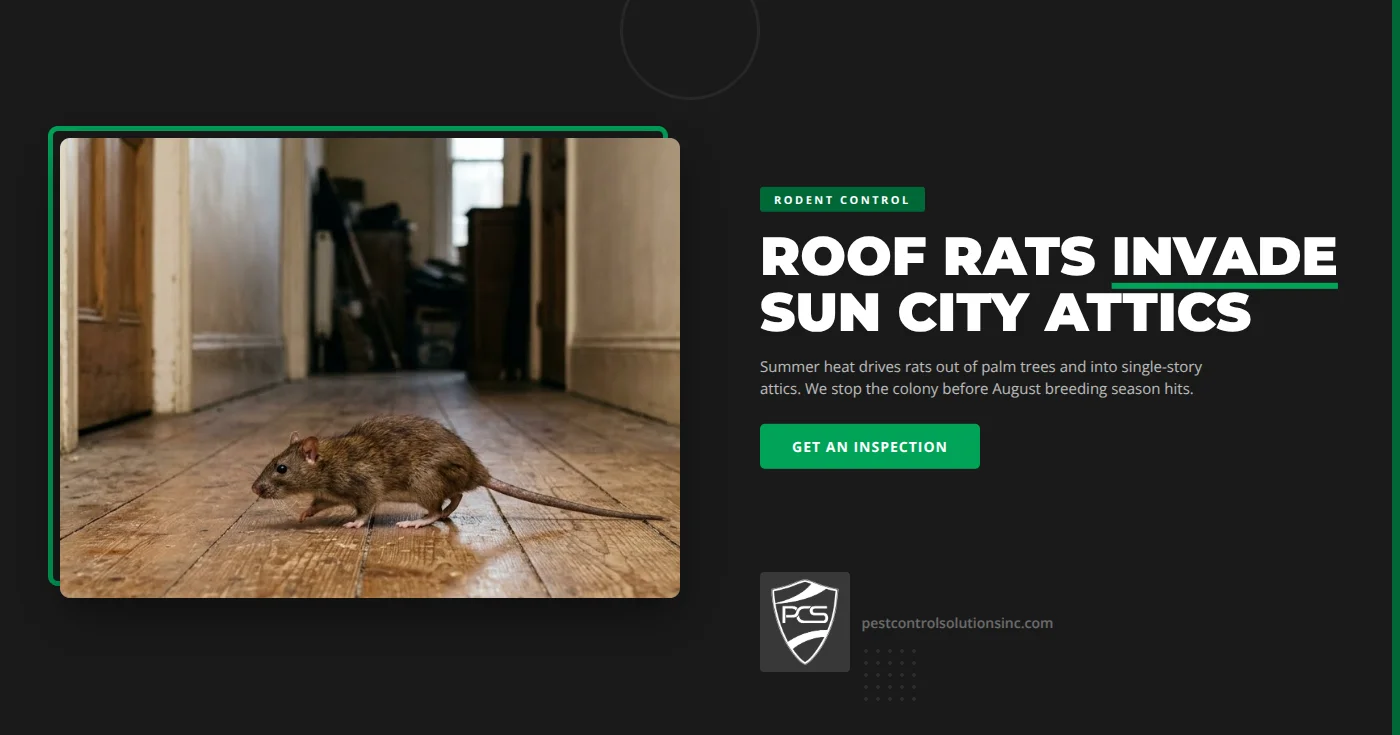
The first week of June reliably opens roof rat season in Sun City, NV, and our phones at Pest Control Solutions start ringing for the same reason every year. As triple-digit afternoons settle in and overnight lows refuse to drop below 80, the colonies that wintered in palm fronds, oleander hedges, and citrus canopies start looking for cooler quarters — and the attics of Sun City's single-story homes are exactly what they want. Roof rat control in Sun City, NV is a summer problem driven by very specific desert conditions, and understanding how heat, landscaping, and home construction combine to push rats indoors is the first step toward stopping an infestation.
Why Sun City Sees More Roof Rats Every Summer
Roof rats are not native to Southern Nevada. They arrived in the Las Vegas Valley in the early 1990s, hitchhiking in shipments of mature palm trees and citrus brought in to landscape the explosion of master-planned communities — including Sun City Summerlin, Sun City Aliante, and Sun City Anthem. Year-round warmth gives them a longer breeding cycle than anywhere else in the country, and irrigated landscaping removes the water scarcity that limits other desert rodents.
Summer changes the dynamic. From October through April, roof rats live almost entirely outdoors — nesting in palm-frond skirts, oleander hedges, and fruit trees. When daytime highs cross 105 and overnight lows stop dropping, those outdoor nests become uncomfortably hot. Attics run cooler than outdoor air at night, and access points along the roofline are easy for a climbing rodent to find.
Sun City's housing stock makes the problem worse. Single-story floor plans put attic eaves within a single leap of a mature palm. Tile roofs have gaps along the eave course and at every penetration. Garage doors with worn weatherstripping leave a quarter-inch gap that a rat squeezes through without slowing down. With many homes lightly maintained while owners spend summer out of state, a colony can move in undetected and breed for six to eight weeks before anyone notices.
How Palm Trees Become Rat Highways Into Your Home
Palm trees are the single biggest driver of roof rat infestations across Sun City. The unpruned skirt of dead fronds at the top of a mature California fan palm or queen palm is the ideal nest site — sheltered from sun, hidden from predators, and warm at night even after the desert cools off. A single mature palm with an established skirt can hold a breeding population of fifteen to twenty rats year-round.
The bridge from palm to attic is short. Rats are exceptional climbers, and a frond touching a roofline is a direct entry path. Even when the canopy is several feet from the structure, they use the trunk as a vertical highway and travel along block walls, irrigation lines, and rooflines to reach attic vents. We routinely inspect Sun City homes where rats have a clear route from a palm-tree skirt to a soffit vent missing its hardware cloth.
Citrus and ornamental fruit trees compound the problem. A productive grapefruit, orange, or pomegranate tree provides a continuous food source from late fall through spring, and oleander hedges along property lines give rats a connected travel corridor at ground level. The single highest-impact landscaping action a Sun City homeowner can take is to have palm trees professionally skinned every spring before nesting begins.
Warning Signs of a Roof Rat Infestation in Your Attic
Roof rats are nocturnal and quieter than mice, so an established population often goes unnoticed for weeks. Learning the warning signs early is the difference between a quick service call and a major remediation project.
Scratching or running sounds in the ceiling at night. Roof rats are active from about thirty minutes after sunset through dawn, with peak movement in the first three hours of darkness. Scurrying across the ceiling drywall after 9 p.m. is the most common first-report symptom.
Droppings in the garage, pantry, or along baseboards. Roof rat droppings are dark, spindle-shaped, and roughly half an inch long — pointed at the ends. Mouse droppings are smaller and more pellet-like.
Gnaw marks on wood, plastic, and wiring. Chewed insulation on attic wiring is a recognized fire hazard and one of the strongest reasons not to ignore activity overhead.
Greasy rub marks along walls and beams. The oils in their fur leave dark smudges along consistent travel paths — edges of attic vents, tops of block walls, and rafters near insulation drop-offs.
Shredded insulation or fruit caches in unusual locations. A hollowed-out area in attic insulation surrounded by shredded fiberglass and paper is an established nest. Half-eaten citrus or pomegranate on garage shelves or attic catwalks is another strong signature — mice do not cache fruit; roof rats routinely do.
Health Risks Roof Rats Bring to Sun City Families
Roof rats are a public health concern beyond the structural damage they cause, which is why we treat an attic infestation as a priority service. The Southern Nevada Health District tracks rat-associated disease vectors closely because the conditions that produce rats — irrigated landscaping, mature trees, dense housing — are the conditions that define the Las Vegas Valley.
The diseases of greatest concern include salmonellosis, leptospirosis, rat-bite fever, and lymphocytic choriomeningitis, all transmitted through contact with droppings, urine, saliva, or contaminated surfaces. Dust kicked up by rodent activity can carry particulate contamination into living areas through recessed lighting and HVAC penetrations. Fleas that travel on rats add a secondary vector — rat fleas can transmit murine typhus, documented across the Southwest, and when a rat dies inside a wall void those fleas leave the cooling body in search of a new host.
Sun City is, by design, a community of active adults aged 55 and older. Older residents and anyone with compromised immune function face elevated risk from any rodent-borne pathogen, so we do not advise patience or watchful waiting on confirmed activity in the attic.
Prevention Steps Every Sun City Homeowner Should Take Now
Strong prevention reduces roof rat pressure dramatically and is the most cost-effective way to manage rodent risk over a multi-year horizon.
Have palms professionally skinned every spring. The single highest-impact action available. Schedule the work in March or April so it is complete before peak summer breeding, and ask for debris haul-away — fronds left on the ground become ground-level harborage within days.
Harvest fruit and clean up fallen produce. Citrus, pomegranate, and fig should be picked as it ripens. Fallen fruit must be removed weekly — leaving it on the ground is the same as putting out a continuous rodent buffet.
Seal openings around the roofline. Install hardware cloth (quarter-inch wire mesh) over every attic vent, soffit vent, roof-jack penetration, and eave gap larger than half an inch. Foam alone does not stop a rat — they gnaw through expanding foam in minutes.
Replace worn garage door weatherstripping. The rubber seal at the bottom of the garage door is one of the most common entry points in Sun City homes. Replace it every two to three years.
Manage irrigation and trim canopies. Fix drip-line leaks, bring pet water bowls inside overnight, and check irrigation timers for over-watering. Maintain at least a four-foot clearance between any tree canopy and the structure, and remove any palm frond extending toward the house.
Why DIY Trapping Rarely Solves a Roof Rat Problem
Hardware stores across northwest Las Vegas stock snap traps, glue boards, and bait stations, and we field calls every week from Sun City homeowners who tried the DIY route for two or three months before bringing us in. The trapping itself is rarely the problem — it is the surrounding work DIY misses.
A trapping-only approach addresses the rats that happen to encounter a trap. It does not address the breeding pair still in the palm tree, the nest in the attic insulation, the unsealed entry points along the roofline, or the fruit tree producing the food supply. We have inspected homes where the homeowner caught twelve rats over six weeks and still had constant activity — the property kept recruiting new rats from the neighborhood faster than traps could remove them.
Bait stations introduce a different problem. A rat that consumes a lethal dose of anticoagulant typically retreats to its nest before dying, and a poisoned rat in a wall void creates an odor problem that lasts weeks plus a flea-displacement event as the parasites leave the cooling body in search of a new host.
Professional control works because it addresses the whole system: identifying the primary nest site, excluding entry points, removing food and water inputs, sustained trapping during the active phase, and follow-up to confirm zero activity over multiple weeks.
How Pest Control Solutions Inc Gets Rid of Roof Rats for Good
At Pest Control Solutions, we have refined our roof rat protocol specifically for the conditions of Sun City — the palm-tree harborage, the tile-roof entry points, the single-story attic geometry, and the summer heat that drives colonies indoors.
Every service call begins with a comprehensive inspection — interior, attic, exterior, and landscaping. We look at every potential nest site, every entry point along the roofline, and every food and water input that could be recruiting rats onto your home.
Exclusion comes first whenever the property condition allows. We seal every active and potential entry point along the roofline with hardware cloth and rodent-rated sealant, repair or replace damaged weatherstripping at garage doors, and address failed vent screens. Without sealed openings, the colony keeps being replenished — exclusion is what makes the trapping phase finite.
Sustained trapping pressure during the active phase uses commercial snap traps and tamper-resistant stations along documented travel routes. Our rodent control technicians service trap lines on a weekly cadence, removing catches and adjusting placements as the colony adapts.
Follow-up confirmation closes the file. After two consecutive weekly services with zero catches, we conduct a final attic inspection and exterior walk. If everything is clean, the property moves onto a quarterly maintenance plan that monitors for reinvasion at a fraction of the cost of full remediation.
Frequently Asked Questions About Roof Rat Control in Sun City, NV
How do I know if I have roof rats and not mice?
Droppings are the most reliable indicator. Roof rat droppings are dark, half an inch long, and spindle-shaped with pointed ends. Mouse droppings are smaller and rice-grain-shaped. Roof rats also prefer overhead spaces — attics, palm trees, garage rafters — while mice stay at ground level.
How long does it take to get rid of roof rats?
A typical Sun City treatment runs four to six weeks. The first two weeks focus on inspection, exclusion, and establishing trap lines. Weeks three through five are sustained trapping. The final week is verification. Larger infestations can run eight to ten weeks.
Will trimming my palm trees stop the rats?
Trimming alone reduces pressure but rarely ends an infestation already inside the attic. The right sequence is trim first, then inspect and seal, then trap the remaining indoor population.
Are roof rats year-round in Sun City or only during summer?
They are present year-round, but visibility shifts seasonally. From late fall through early spring, they nest outdoors and rarely enter homes in significant numbers. As temperatures climb in May and June, indoor migration begins and attic activity peaks from June through September.
Can I do anything while I am out of town for the summer?
Many Sun City residents spend summer out of state, which is when rats are most likely to move in undetected. We recommend a pre-departure inspection and seal-up service in late May, plus quarterly check-ins during the absence.
Early June is the moment to act on roof rat activity in Sun City, NV. Colonies still outdoors today will be looking for attic entry points within the next four to six weeks, and a property that is sealed, trimmed, and monitored before the push begins almost always avoids the cost of a full infestation. Whether you have heard scratching in the ceiling or want a seasonal inspection before summer hits its peak, contact Pest Control Solutions today — our team serves Sun City and the surrounding northwest Las Vegas communities with rodent control built for the conditions that drive rats into Nevada homes every summer.