
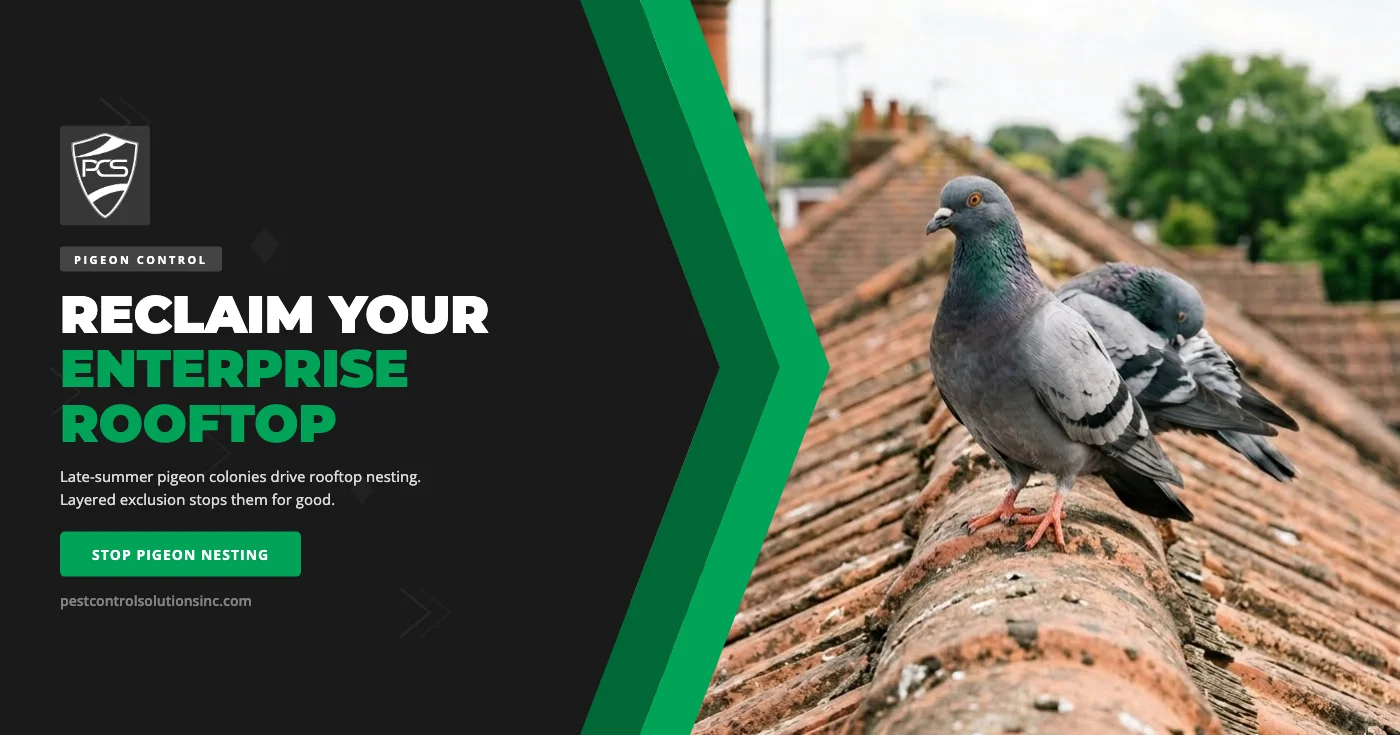
Every August and September the calls from Enterprise homeowners follow the same pattern — scratching above the master bedroom, white streaks running down the second-story stucco, and pigeons dropping onto the driveway from above the garage. Pigeon control in Enterprise, NV is a late-summer specialty for our team at Pest Control Solutions because late summer is when this year's spring broods reach maturity and start prospecting their own nesting sites — often on the same roofs where they hatched.
We run pigeon control in Enterprise, NV every week alongside jobs in Southern Highlands, Mountains Edge, and the rest of the south valley. Feral pigeons are non-migratory, so a colony that establishes this month will still be there in December unless something interrupts it. Understanding why late summer is the pressure point — and what the birds do to tile roofs, solar arrays, and HVAC units — is the first step to keeping them off the property.
Why Enterprise, NV Rooftops Attract Pigeons in Late Summer
Enterprise was built or rebuilt in the last two decades, which means Spanish and Mediterranean tile roofs on the majority of homes and rooftop solar on a growing share of them. Both features create dozens of small cavities that hold cooler air long after the surrounding roof has heated up — and to a pigeon scouting a nest in late August, that gap is an ideal mix of shade, predator protection, and easy fly-in access.
Late summer is also when this year's spring hatchlings finish maturing. A pair of desert pigeons can produce four to six broods between March and October, and the earliest juveniles are now fully grown and looking for their own territory. They almost always start within a few hundred yards of the roof where they were raised, which is why one nesting pair in the spring becomes a small colony by late summer and a large colony by the following year.
The third factor is heat. Once surface temperatures on open desert lots cross 130°F in July and August, pigeons abandon ground roosts and crowd onto residential structures where tile and stucco hold slightly less heat. Add reliable water from irrigation and AC condensate lines, plus a steady food supply from pet bowls and shopping-center dumpsters along Blue Diamond and St. Rose, and Enterprise has everything a desert pigeon needs to settle in.
Health and Well-Being Risks of a Pigeon Infestation on Your Property
Late-summer heat does something to pigeon droppings that catches a lot of homeowners off guard. Once droppings bake on a hot roof for a few weeks, they dry into a fine powder that breaks apart easily and drifts on the breeze — and that airborne powder is the reason summer is the higher-risk season for the diseases associated with pigeon waste.
The most well-documented concern is histoplasmosis, a respiratory infection caused by a fungus that grows in soil and materials enriched with bird droppings. The CDC notes that disturbing accumulated droppings can release fungal spores into the air, which is why any large cleanup should be handled by professionals using the right protective equipment (Histoplasmosis and Work, CDC). Symptoms typically appear 3 to 17 days after exposure and include fever, cough, and fatigue. People with weakened immune systems are at highest risk, but even healthy adults doing their own rooftop cleanup without a respirator have ended up in urgent care.
Beyond histoplasmosis, pigeons carry mites and lice that move off the birds and into nearby attics once a colony reaches a certain size. Building-science research puts total U.S. property damage from feral pigeons in the billions of dollars per year, because acidic droppings keep attacking surfaces long after the birds have moved on (InterNACHI on pest birds and buildings). We have also pulled dead pigeons out of roof voids that produced strong odors and drew secondary pests — flies, beetles, and ant trails that bring an unrelated infestation to the front door.
Where Pigeons Nest and Roost on Enterprise Homes and Businesses
After years of Enterprise pigeon calls, we can predict with high accuracy where a nest will be on a given property. A handful of locations account for the majority of the colonies we remove.
Under the eaves and behind the fascia. The overhang creates shade, protects the nest from monsoon rains, and puts the colony out of reach of ground predators. Pigeons only need about two inches of clearance to squeeze into a cavity.
Inside Spanish and Mediterranean tile voids. The natural gap under each row of tile is exactly the shape a pigeon looks for. Bird stops are supposed to close those gaps at installation, but in older Enterprise roofs the stops are missing, cracked, or shifted enough for a bird to work through.
Under rooftop solar arrays. The three-to-six-inch gap between a panel and the roof deck creates the largest, most sheltered cavity on the entire structure. Any solar install without a perimeter exclusion is a pigeon nest waiting to happen.
Attic vents, dryer vents, and roof penetrations. Any opening larger than two inches is a candidate for entry into a wall void or attic, where a colony expands into insulation and grows far larger than an outdoor nest. We inspected an Enterprise home last summer where a bird had come through a torn attic-vent screen and eleven pigeons were nesting inside.
Rooftop HVAC cabinets, chimney caps, and parapet ledges. Commercial buildings and larger custom homes give pigeons plenty of horizontal ledge to roost on, and warm HVAC cabinets become a preferred perch after sunset.
Solar Panels and Pigeons: A Growing Problem for Enterprise Homeowners
Rooftop solar has exploded across Enterprise in the last five years, and solar-related pigeon calls have grown alongside it. The geometry is the reason: a pigeon wants a horizontal surface with a ceiling over it and open sides for fly-in — which is exactly what the underside of a panel provides.
Once a pair claims that cavity, damage builds fast. Nesting debris and droppings accumulate on the roof surface beneath the panels, and the acidic content slowly attacks the underlayment where you cannot see it. Buildup also restricts the airflow the array needs, so infested sections run hotter than clean sections on the same roof — and warmer panels produce less power and degrade faster.
The other problem is the warranty stack. DIY exclusion that drills into the panel frame or roofing usually voids one warranty or the other. The correct method uses rigid galvanized mesh clipped to the panel frame with stainless brackets — no drilling, no adhesive — which keeps both warranties intact and permanently closes the cavity. That is what we use on every Enterprise solar exclusion job.
Why Pigeons Are Difficult to Remove Without Professional Help
Most over-the-counter pigeon products fail in Enterprise for the same reason: they treat a single perch instead of solving the access problem. We have walked Enterprise rooftops where the homeowner had installed plastic owls, reflective streamers, and half a dozen scattered spike strips — and the birds were nesting six feet from every one of them. Once pigeons have claimed a roof, they treat generic deterrents as background noise within days.
Trap-and-relocate rarely works either — pigeon homing instinct brings them back from ten or fifteen miles away. What actually solves the problem is physical exclusion: closing the specific gaps the birds are using so the roof is no longer viable. DIY also falls short on cleanup — removing a nest without respiratory protection or pheromone-trail treatment draws replacement birds within weeks. Every pigeon removal in Enterprise, NV that we perform ends with full sanitation.
Pigeon Deterrent and Exclusion Options That Work in the Desert Climate
Desert conditions eliminate a lot of the pigeon deterrents in Enterprise, NV that work in other regions. Gels degrade within weeks in 110°F sun, reflective tape stops working after the first few dust storms, and ultrasonic devices have no measurable effect on pigeons at any temperature. What does hold up is a layered exclusion plan built around the specific geometry of the property.
- Tile gap closure with rigid bird stops at the eaves so the voids under Spanish and Mediterranean tiles are no longer accessible.
- Solar panel exclusion using rigid galvanized mesh clipped to the panel frame — no drilling into the panel or roof, so both warranties stay intact.
- Targeted bird spikes on the specific ledges, parapets, chimney caps, and HVAC cabinet edges where the birds actually land.
- Vent screening with quarter-inch hardware cloth on attic vents, soffit vents, and roof penetrations.
- Habitat reduction and sanitation — trimming roof-shading palms, clearing accumulated nest material, and neutralizing the pheromone trail that drew the birds in.
Timing matters as much as materials. Closing gaps in late summer, before the fall clutches are laid, prevents the colony from doubling over the mild Enterprise winter. Waiting until spring usually means twice the exclusion footage, twice the cleanup, and a much higher chance the underlying roof or solar damage has already started.
How Pest Control Solutions Handles Pigeon Removal in Enterprise, NV
Our team runs pigeon control in Enterprise, NV the same way every time. Every project begins with a full property inspection — walking the roof where the pitch allows, using ladders and binoculars where it does not, and mapping every active nest, roost, and entry point. From that map, we build a written exclusion plan covering each gap, perch, and cleanup zone.
The physical work follows the layered plan above: tile gap closure at the eaves, rigid mesh around any solar array, targeted spikes on the actual landing surfaces, screened vents, and full sanitation of the roosting and nesting sites. Because pheromone residue draws replacement birds to a cleared roof, sanitation is not an optional add-on — it is what separates a permanent solution from a job that has to be repeated next season.
Many Enterprise families pair pigeon exclusion with our residential pest control program so the roof, yard, and perimeter are all under one team — particularly effective in late summer when pigeon activity peaks alongside scorpions, cockroaches, and ants. Our pigeon control service covers Enterprise, Southern Highlands, Mountains Edge, and the rest of the south valley, with same-day inspections for active nesting.
Frequently Asked Questions About Pigeon Control in Enterprise, NV
How quickly can pigeons damage an Enterprise tile roof?
Visible underlayment damage usually appears after one to two summers of continuous nesting, but moisture trapped under the tiles can start working on the felt within a single monsoon season. Most roof leaks we trace back to pigeons started two or three years before the first ceiling stain appeared inside.
Will pigeons leave on their own once summer ends?
No. Pigeons in the Las Vegas Valley are non-migratory, and mild Enterprise winters do nothing to displace an established colony. Without exclusion, the same birds keep breeding through fall and enter next spring with a larger population than they started with.
Are pigeon deterrent gels and reflective streamers effective in the Enterprise climate?
In our experience, no. Gels degrade quickly in 110°F sun, and reflective tape loses effect after a few weeks of dust and monsoon storms. Exclusion is the only long-term approach we have found that holds up in the desert.
Can you remove pigeons from under solar panels without voiding the warranty?
Yes. Rigid galvanized mesh clipped to the panel frame with stainless brackets keeps both the roof and solar warranties intact while permanently closing the nesting cavity — no drilling into the panel or the roof.
How long does a typical Enterprise pigeon exclusion job take?
Most single-family homes are completed in one to two visits. Larger custom homes with extensive solar or significant cleanup needs may take longer, but the bulk of the physical work is usually finished within a week of the initial inspection.
Late summer is when Enterprise pigeon colonies reach peak size and start prospecting the next round of nesting sites. Whether you see droppings on the driveway, hear scratching in the attic, or notice birds disappearing under a solar array at midday, contact Pest Control Solutions today for same-day pigeon control in Enterprise, NV.