
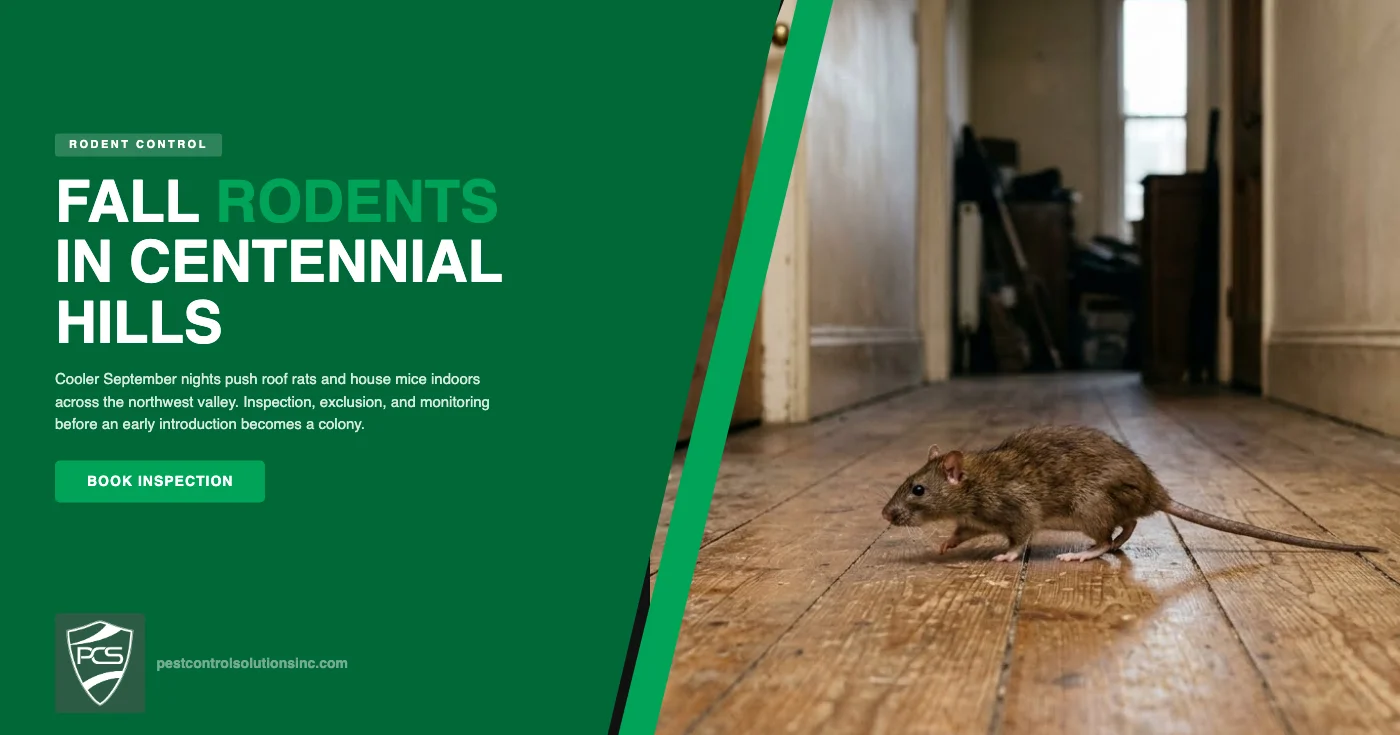
Every year the first cool overnight low in Centennial Hills flips a switch on our phone lines. Late September into October is when residents start hearing scratching in the attic, finding pellet droppings behind the pantry, or spotting a small brown blur across the garage floor at dusk. Rodent control in Centennial Hills, NV becomes an active conversation for our team at Pest Control Solutions the moment desert nights start dropping below 65°F — the threshold that pushes roof rats and house mice from outdoor foraging into home structures.
We handle rodent control across Centennial Hills, Aliante, Summerlin, and every northwest valley community. Newer stucco homes with tile roofs, mature palm trees, and irrigation that runs into November make this corner of the valley one of our busier fall rodent zones. This guide walks through the seasonal drivers, the entry points we find during inspections, and how a professional treatment differs from the retail solutions homeowners try first.
Why Fall Drives Rodents Into Centennial Hills Homes
Rodent behavior in the Mojave follows a predictable seasonal curve. Through peak summer, roof rats and house mice stay outdoors — foraging under palm fronds, in landscape mulch, and along irrigation lines where moisture and shade are constant. As overnight temperatures drop into the low 60s and eventually the 50s, the same colonies scout warmer environments. Attics that hold radiant heat, garage rafters, and wall voids next to gas water heaters become higher-value real estate than the exterior burrows they used all summer.
The National Pest Management Association's Fall & Winter 2026 Bug Barometer flagged this exact pattern for the desert Southwest — warmer-than-average early fall temperatures are extending outdoor breeding cycles, so the colonies moving indoors this October are larger than in a typical year (NPMA Fall Forecast, News 3 Las Vegas). In Centennial Hills, newer construction and mature landscaping create a wide range of shelter options within a single square mile.
Two species drive nearly every residential call we run in this corridor. Roof rats — slender, dark-brown climbers with a tail longer than their body — have been established in the valley since the early 1990s and thrive in palm trees, tile roof edges, and attics. House mice are the other constant, and their small size means they can slip through a gap the diameter of a No. 2 pencil. Both breed year-round in a heated interior, which is why a single early-fall introduction can become a full colony by January.
Common Entry Points Rodents Use in Nevada Desert Homes
Our team runs the same exterior inspection on every Centennial Hills rodent call, and the same handful of entry points show up over and over. Desert construction has a specific set of vulnerabilities that homeowners rarely think about until a rodent has already exploited one.
Weep holes along stucco brick lines. Ventilation gaps at the base of exterior walls let moisture escape, but a house mouse fits through most of them unmodified. We install stainless-mesh weep-hole covers as a standard exclusion measure on every rodent job.
Garage door thresholds and side jambs. Warped rubber sweeps, worn side seals, and the gap where the door meets the slab are among the most common entry points we document. A house mouse needs a quarter-inch opening, and a young roof rat needs about a half-inch.
Roof-to-wall junctions and tile edges. Roof rats travel along power lines and palm fronds, then use tile roof edges and open ridge caps to reach attic voids. On newer Centennial Hills builds we frequently find degraded or wind-dislodged bird stops under the first course of tile.
Utility line penetrations. Where cable, HVAC lineset, and gas line penetrations pass through exterior walls, the sealant often shrinks or fails after a few Nevada summers. The temperature differential guides rodents right to these gaps.
Dryer vents and bathroom exhaust vents. A dryer vent flap that no longer seals fully is a highway. Metal-mesh insert covers go on every vent penetration during the initial exclusion phase.
Signs of a Rodent Problem You Should Not Ignore
Rodents are nocturnal and secretive, so the earliest indicators are physical evidence rather than sightings. Our team trains homeowners to check five distinct signs during any late-September or early-October inspection routine.
- Droppings in specific patterns. House mouse droppings are rice-grain size and pointed on both ends. Roof rat droppings are larger — a quarter to a half-inch, kidney-bean shaped, often left in lines along a travel route. A cluster of fresh droppings near a food source or along a baseboard is the most reliable early sign.
- Grease marks along baseboards, cabinet edges, and beam runs. Rodents follow the same paths repeatedly, and the oils in their fur leave a dark smudge on painted surfaces. A rub mark along a rafter or truss chord is a strong indicator of an established travel route.
- Gnaw marks on wiring, plastic containers, or wood trim. Rodent incisors grow continuously, so they must gnaw to wear them down. Bite marks on wire insulation, plastic storage bin lids, or pantry boxes signal an active population.
- Nesting material in insulation, garage boxes, or storage corners. Rodents shred insulation, palm frond fibers, cardboard, and fabric to build nests. Matted or pulled-apart attic insulation is worth a flashlight inspection.
- Scratching or scurrying noises overhead at night. Roof rats are active in the ceiling and attic between roughly 9 p.m. and 4 a.m. A regular pattern of overhead noise after sundown should trigger an inspection the next day.
The health risk from ignoring these signs is real. The CDC identifies rodents as vectors for hantavirus, salmonella, and leptospirosis, with rodent infestation in and around the home remaining the primary risk factor for hantavirus exposure (About Hantavirus, U.S. CDC). Droppings should never be swept dry — the CDC recommends spraying with a bleach solution first and cleaning with gloves and a mask.
DIY Prevention vs. Professional Rodent Control in Las Vegas
Homeowners often ask us where a hardware-store approach stops working and a professional treatment becomes the more sensible investment. DIY prevention has a real role — but only before an established colony is present. Once droppings, gnaw marks, or overhead activity appear, the math changes.
Effective DIY prevention starts outside and works inward. Trim palm fronds and tree branches back at least four feet from the roofline to break the aerial highway roof rats rely on. Move woodpiles and stored items at least twenty feet from the foundation. Store food in hard-sided containers rather than cardboard, and empty pet bowls overnight. Fix outdoor irrigation leaks — even a small drip provides the water source a colony needs.
Where DIY falls short is entry-point identification and colony estimation. A homeowner with a flashlight finds the obvious gaps, but our exclusion inspections routinely turn up six to twelve entry points on a single home — many in roof, attic, and utility-line locations that require a ladder and technical knowledge. Retail snap traps and rodenticides knock down the visible portion of a population, but a breeding pair of roof rats can produce up to forty offspring per year. Missing one nesting site restarts the population within weeks. The most expensive rodent problems we see in Centennial Hills are the ones where a homeowner tried three or four rounds of retail rodenticide before calling — the exclusion then has to happen alongside active trapping instead of before it.
How Pest Control Solutions Inc Handles Rodent Infestations in Centennial Hills
Every rodent control Centennial Hills NV service call our team runs starts with the same three-part protocol: full-property inspection, exterior exclusion, and interior population knockdown with follow-up monitoring. The sequence matters — exclusion before knockdown is what separates a permanent solution from a recurring service subscription.
The inspection covers the roof line, attic access, garage, all exterior wall penetrations, the yard perimeter, and the interior spaces the homeowner has flagged. Our technician documents every entry point, travel route, and evidence cluster on a written inspection sheet. In a typical Centennial Hills two-story stucco home we find six to fifteen actionable gaps.
Exclusion seals every documented entry point with the correct material: stainless-steel mesh for weep holes and vents, copper mesh and sealant for utility penetrations, metal flashing for tile roof edges, and reinforced door sweeps for garage and side doors. Metal matters because rodents can gnaw through spray foam, wood, and most sealants in days.
Interior knockdown uses tamper-resistant bait stations at exterior stations and multi-catch snap traps along documented interior travel routes. Loose rodenticide is never left accessible to pets or children — every bait application uses a locked station. Follow-up monitoring runs on two-week and four-week schedules. The two-week check verifies exclusion held and measures knockdown; the four-week check confirms zero new evidence and transitions the property onto our quarterly home pest control program if the homeowner wants ongoing coverage.
Why Early Action Saves Centennial Hills Homeowners Time and Money
The cost curve on a rodent problem is steep. A single-visit inspection and exclusion on an early introduction — droppings spotted, no wire damage, no attic activity — is a one-time investment. An established colony with attic contamination, chewed wiring, and damaged insulation runs several times that cost because the remediation compounds: exclusion, knockdown, insulation replacement, wire repair, and often an HVAC cleaning to address droppings in the duct system.
The timeline compresses in the wrong direction, too. A rodent problem caught in early October is a two-visit fix over three or four weeks. The same problem in January is a six-week project because the population has multiplied across multiple rooms. Fire risk from gnawed wire insulation and health risk from droppings both climb every week the colony is active.
The homeowners who fare best treat the first sign — a single dropping, a single overhead noise, an unexplained gnaw mark on a garbage bag — as reason enough to schedule an inspection. If any of the signs above apply to your Centennial Hills home, contact Pest Control Solutions today to schedule a rodent control inspection before an early-fall introduction becomes a winter-long infestation.
Frequently Asked Questions About Rodent Control in Centennial Hills
Are roof rats a bigger problem than house mice in Centennial Hills?
Both are common, but the balance shifts by neighborhood. Areas with mature palm trees, block-wall irrigation channels, and tile roofs tend to have higher roof rat pressure. Newer subdivisions with sparser landscaping see more house mouse activity. Our inspections identify which species is present so the exclusion and monitoring plan can be tuned to it.
How do rodents get into a modern stucco home?
The most common entry points on newer Centennial Hills construction are weep holes at the base of the stucco, garage door threshold gaps, roof-to-wall junctions at tile edges, and utility line penetrations where sealant has failed. A mouse needs a quarter-inch gap; a roof rat about a half-inch — both are easy to overlook without a targeted inspection.
What are the health risks from rodents in Nevada?
The CDC lists rodents as vectors for hantavirus, salmonella, leptospirosis, and other pathogens. In the desert Southwest, hantavirus is the highest-profile risk because deer mice — a rural species that occasionally makes its way into homes along the valley edge — can carry it. Droppings should never be swept dry; the CDC recommends spraying with a bleach solution first and cleaning with gloves and a mask.
Do retail rodenticides work long-term?
Retail rodenticides can reduce a visible population, but they rarely solve a rodent problem because they do not address the entry points that let the population establish. Our team often responds to homes where three or four rounds of retail bait were used first — the population rebuilds within weeks because new rodents keep entering through the same unsealed gaps.
When should Centennial Hills homeowners schedule a rodent inspection?
The optimal window is late September through mid-October, before the first indoor introduction. If any of the signs above are already present — droppings, gnaw marks, overhead noise, grease trails — schedule the inspection immediately. Every week of delay increases the population size, the damage, and the total cost of the eventual treatment.