
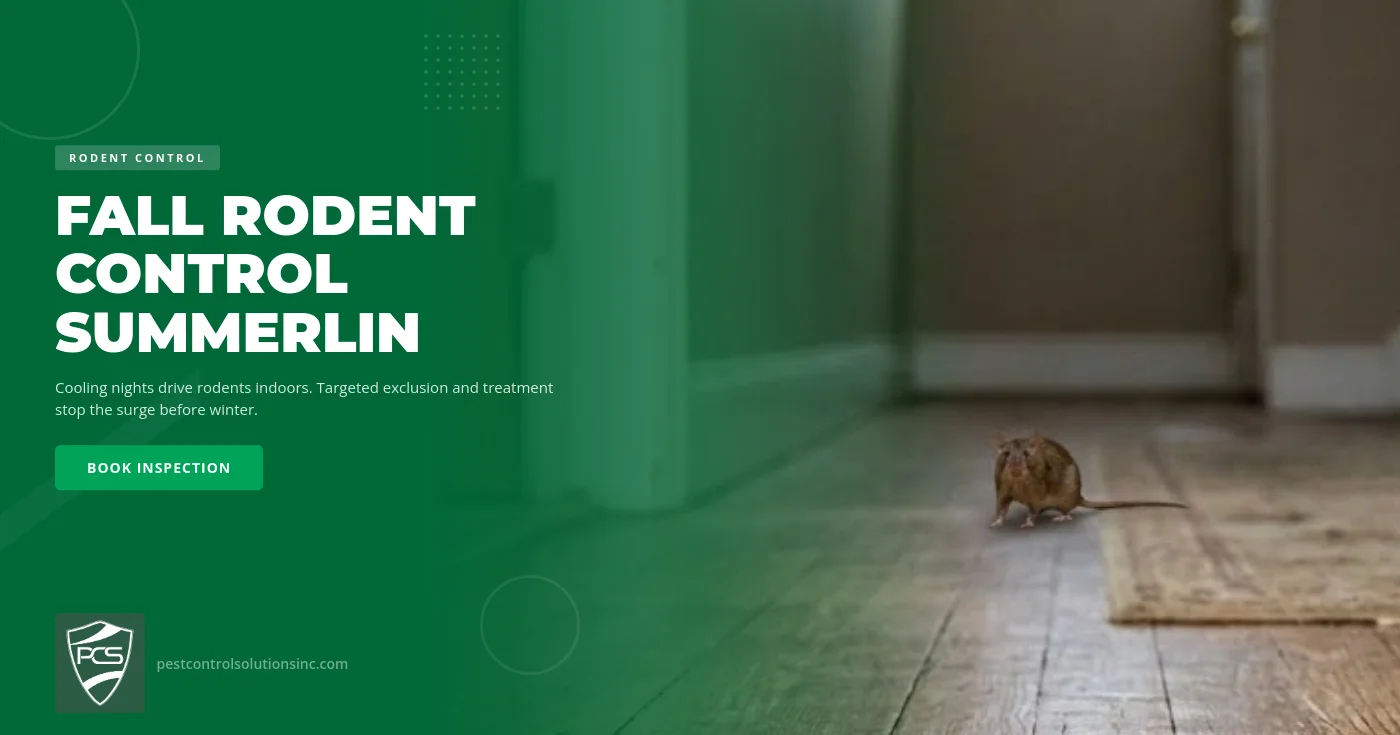
Walk outside in Summerlin after sunset in early October and you can feel it — the daytime still touches the mid-80s, but the air drops twenty degrees after the sun ducks behind the Spring Mountains. For us, that nightly cooldown reliably predicts our busiest rodent calls of the year. The transition from desert summer to desert fall triggers one of the biggest shifts in local wildlife behavior we see — and your home becomes a magnet in ways that have nothing to do with how clean your kitchen is.
At Pest Control Solutions Inc, we service homes across Summerlin, Las Vegas, Henderson, and the rest of the valley. Here's what we've learned about why October through December brings so many rodent problems to this part of the Mojave — and what you can do before a single mouse turns into a wall full of them.
Why Fall Temperatures Trigger Rodent Invasions in Summerlin, NV
The Mojave Desert runs on diurnal temperature swings — the gap between daytime highs and nighttime lows. In July, the swing is just as wide, but even overnight lows stay around 80°F. What changes in fall is that the nighttime lows drop fast. A typical early-October day in Summerlin might peak at 88°F and drop to 54°F overnight. By late October, overnight lows regularly touch the 40s.
Rodents are endotherms — they generate their own body heat — which means cold nights force them to burn calories just to maintain core temperature. At the same time, their natural food sources start thinning out. Seeds dry up, insects become scarce, and the vegetation along desert washes and open space corridors loses its moisture content. Your attic, your garage, your pantry, and your crawl spaces offer everything a rodent needs in one convenient package: warmth, water, calorie-dense food, and insulated nesting material.
Fall is also when many rodent species hit a reproductive push. According to the Centers for Disease Control, roof rats and house mice can produce multiple litters per season, with populations surging when temperatures encourage indoor sheltering. Combine that biology with Summerlin's position at the edge of Red Rock Canyon's open space, where desert mammals funnel into suburban communities every autumn, and you have a textbook recipe for an October rodent problem.
Which Rodents Are Most Common in Summerlin Homes in October
Not every rodent that scratches in your attic is a mouse. Here's what we most often identify on Summerlin service calls this time of year:
Roof rats (Rattus rattus). These are the climbers. They scale palm trunks, telephone lines, and stucco walls to reach rooflines, then enter through vents, loose soffits, or chimney flashing. Roof rats are the single most common rat species we trap in master-planned communities like Summerlin — the mature palms and dense landscaping are exactly what they prefer. They nest in attics and shred insulation for bedding.
House mice (Mus musculus). Smaller, more opportunistic, and happy to live in wall voids, pantry corners, or garage storage boxes. A house mouse can squeeze through a gap the diameter of a dime. They multiply fast — a single pair can produce 30 to 50 offspring in a single breeding season.
Deer mice (Peromyscus maniculatus). Common along the western edge of the valley near Red Rock and in neighborhoods bordering open desert. Deer mice are a known reservoir for hantavirus, which is why the CDC specifically warns against sweeping or vacuuming rodent droppings in enclosed spaces — aerosolized particles are the primary transmission route.
Pack rats (desert woodrats). The hoarders. They build messy, debris-filled nests called middens in garages, sheds, engine compartments of parked cars, and under outdoor equipment. Pack rats are notorious in the Las Vegas valley for chewing through car wiring — a problem that spikes every fall as they look for sheltered nesting spots.
Where Rodents Enter Summerlin Homes — and Where They Nest
Rodents don't need an open door. House mice can slip through a 1/4-inch gap; rats need only 1/2 inch. In our Summerlin inspections, the entry points we flag most often are:
- Roof vents and ridge vents — especially when screening has aged, lifted, or been damaged by UV exposure.
- Weep screed gaps along the base of stucco walls — original construction gaps that rarely get sealed.
- Utility penetrations where gas, electric, and plumbing lines pass through walls and roof decks. Caulk cracks and separates in the desert sun.
- Garage door bottom seals — one of the single most common failure points we see. A worn or warped seal leaves a half-inch gap that a mouse treats as a doorway.
- Chimney flashing and transitions between roof planes.
- Palm tree fronds touching the roofline — these are literal highways for roof rats.
- Dryer vents missing a louvered cover or damper.
Once inside, rodents gravitate toward attics (shredded insulation becomes nesting material), wall voids, HVAC closets, kitchen cabinet backs, under appliances, and garage storage areas. If you have holiday decorations or stored cardboard boxes in the garage, that's prime nesting real estate.
Warning Signs of a Rodent Problem in Your Summerlin Property
Most homeowners we visit noticed something before they called us — they just weren't sure what they were seeing. The signs we tell people to watch for:
- Droppings. Rice-grain-sized and black means mice; raisin-sized and dark means rats. Fresh droppings are moist; older ones are brittle. Clusters near pantries, under sinks, or along garage baseboards are telling.
- Gnaw marks. Rodents must chew constantly to wear down their incisors. Look for chewed cardboard, plastic food packaging, wood framing, and — most dangerously — electrical wiring insulation.
- Rub marks. Rodents follow the same travel paths repeatedly, leaving oily smudges along baseboards, pipes, and ceiling joists.
- Nest material. Shredded insulation, fabric, paper, or cotton stuffed into dark corners.
- Night sounds. Scratching, scurrying, or thumping in attics, walls, or ceilings — most active between dusk and 2 a.m.
- Pet behavior. A dog or cat suddenly fixated on a wall, a ceiling spot, or a cabinet is often responding to something you can't hear yet.
If you spot more than one of these signs, don't assume you have "a mouse." Rodents are social, and visible evidence typically means a breeding group has already established itself.
DIY Rodent Prevention Steps for Summerlin Homeowners This Fall
Prevention is where homeowners can do real work before the problem gets established. We recommend the following every October:
- Seal entry points. Walk the exterior of your home with a flashlight at dusk. Mark every gap larger than 1/4 inch and seal it — expanding foam for small voids, hardware cloth (1/4-inch mesh) for larger openings, caulk for cracks around utility penetrations.
- Trim palm fronds back from the roof. Aim for six feet of clearance between fronds and any roof edge. The University of Nevada Cooperative Extension notes that landscape management is one of the most effective rodent-prevention tools in desert environments.
- Store pantry food in airtight containers. Rice, flour, cereal, pet food, and birdseed should all live in sealed glass or heavy-duty plastic — not the original paper or thin plastic packaging.
- Eliminate water sources. Fix dripping outdoor faucets, drain pet water bowls overnight, and check for condensation around HVAC lines and water heaters. In the Mojave, rodents will prioritize water above almost everything.
- Keep garage doors closed. Even a 15-minute open window during cool evenings is enough for a mouse to scout, memorize the layout, and return.
- Clear yard debris. Woodpiles, construction scraps, and dense ground cover against the house give rodents staging areas. Keep woodpiles at least 20 feet away and elevated.
- Replace worn weatherstripping on garage and exterior doors. If you can see daylight at the bottom of the door, a rodent can walk under it.
Why DIY Methods Fall Short Against Fall Rodent Pressure in the Desert
We'll be straight with you: the prevention steps above help, but they rarely solve an active infestation. Here's why DIY plateaus:
Rodents reproduce fast enough to outrun casual trapping. A pair of house mice that establishes in October can grow to 30 or more individuals by Christmas. Snap traps and glue boards catch the curious and the hungry — not the breeding females that stay deeper in the nest.
Over-the-counter baits are a mixed bag. The Environmental Protection Agency restricts the most effective rodenticides to licensed applicators because improper placement creates risks for pets, children, and non-target wildlife. Hardware-store products are deliberately less potent — and rodents learn to avoid them.
Finally, finding entry points is a trained skill. Our technicians routinely identify access points behind HVAC equipment, inside soffit returns, and through roof vent screens that look fine from the ground.
Professional Rodent Control in Summerlin from Pest Control Solutions Inc
Our Summerlin rodent control service is built around the way desert rodents actually behave — not around a one-size-fits-all template. Every property we treat gets:
- A full exterior and interior inspection, including attic access when conditions allow, to identify active entry points, nesting zones, and travel corridors.
- Exclusion work — the sealing, screening, and weatherstripping that keeps new rodents from replacing the ones we remove. Exclusion is the difference between a one-time service and lasting control.
- Species-appropriate trapping and baiting, placed in tamper-resistant stations when pets or children are a factor on the property.
- Follow-up visits scheduled on a cadence that matches your situation — more intensive at first, tapering as activity drops.
- Homeowner education: what to watch for, what to do between visits, and how to make your property less attractive long-term.
We've been serving Summerlin and the Las Vegas valley long enough to know the local rodent playbook — the shortcuts roof rats take through palm trees, the way pack rats stake out garages, where house mice love to settle in Summerlin's two-story floor plans. We bring that experience to every call.
If you've seen signs of rodent activity, or if you want to get ahead of the fall surge before it starts, learn more about our rodent control services and schedule an inspection with our team. The sooner we identify entry points and start exclusion work, the easier the whole season gets.
Frequently Asked Questions
How quickly can one rodent turn into an infestation in Summerlin, NV?
Faster than most homeowners expect. A pair of house mice can produce five to ten litters per year, with four to six pups per litter, and pups reach breeding age in six to eight weeks. A single pair arriving in early October can produce 30 or more descendants by late December.
Are rodents in Summerlin, NV dangerous to my family's health?
They can be. Deer mice carry hantavirus, which spreads through aerosolized droppings and urine particles. Rats and mice can also transmit salmonella and leptospirosis, and their droppings and dander trigger asthma and allergy symptoms. The CDC recommends against sweeping or vacuuming suspected droppings — damp paper towels and a disinfectant solution are the recommended cleanup method.
What's the best time of year to start rodent control in Summerlin, NV?
September and early October — before the first real cold snap drives rodents indoors. Prevention work done in warm weather is faster and cheaper than remediating an established infestation in December. If you're reading this in late fall and already seeing signs, don't wait — populations only grow between now and February.
Will trimming my palm trees really reduce roof rats?
Yes, significantly. Palm trees are the single biggest attractor for roof rats in Summerlin neighborhoods. Mature palms provide dense frond skirts for nesting cover and continuous access from ground to roof. We recommend annual frond trimming and keeping frond tips at least six feet from roof edges.
Can I use rodenticides I buy at a hardware store in Summerlin, NV?
You can, but we don't recommend it. Hardware-store rodenticides are deliberately formulated to be less potent than professional-grade products because of the risks to pets and non-target wildlife. Secondary poisoning of family dogs and raptors is a real concern. Licensed applicators place tamper-resistant stations in locations rodents actually use.
How Does Pest Control Solutions Handle Rodent Control in Summerlin, NV?
Rodent activity in Summerlin, NV accelerates sharply in October as overnight temperatures start dropping into the 50s and 40s. Roof rats work palm trees and rooflines, house mice slip through quarter-inch garage door gaps, and pack rats stake out sheds and parked vehicles. Fall is the single most important window to get ahead of the breeding push before populations compound through winter.
At Pest Control Solutions, we run rodent control across Summerlin, Las Vegas, Henderson, and every valley community where the desert edge meets residential rooflines. Every visit starts with a full exterior and attic-access inspection to map entry points, nesting zones, and travel corridors — then exclusion work (sealing, screening, weatherstripping), species-appropriate trapping and baiting in tamper-resistant stations where pets and children are a factor, and scheduled follow-ups tuned to activity levels.
Customers who get on a recurring plan see the strongest long-term results, because exclusion plus baseline treatment keeps new rodents from replacing the ones we remove. Contact us today to schedule a Summerlin rodent inspection and get fall exclusion work in place before the overwintering push accelerates.