
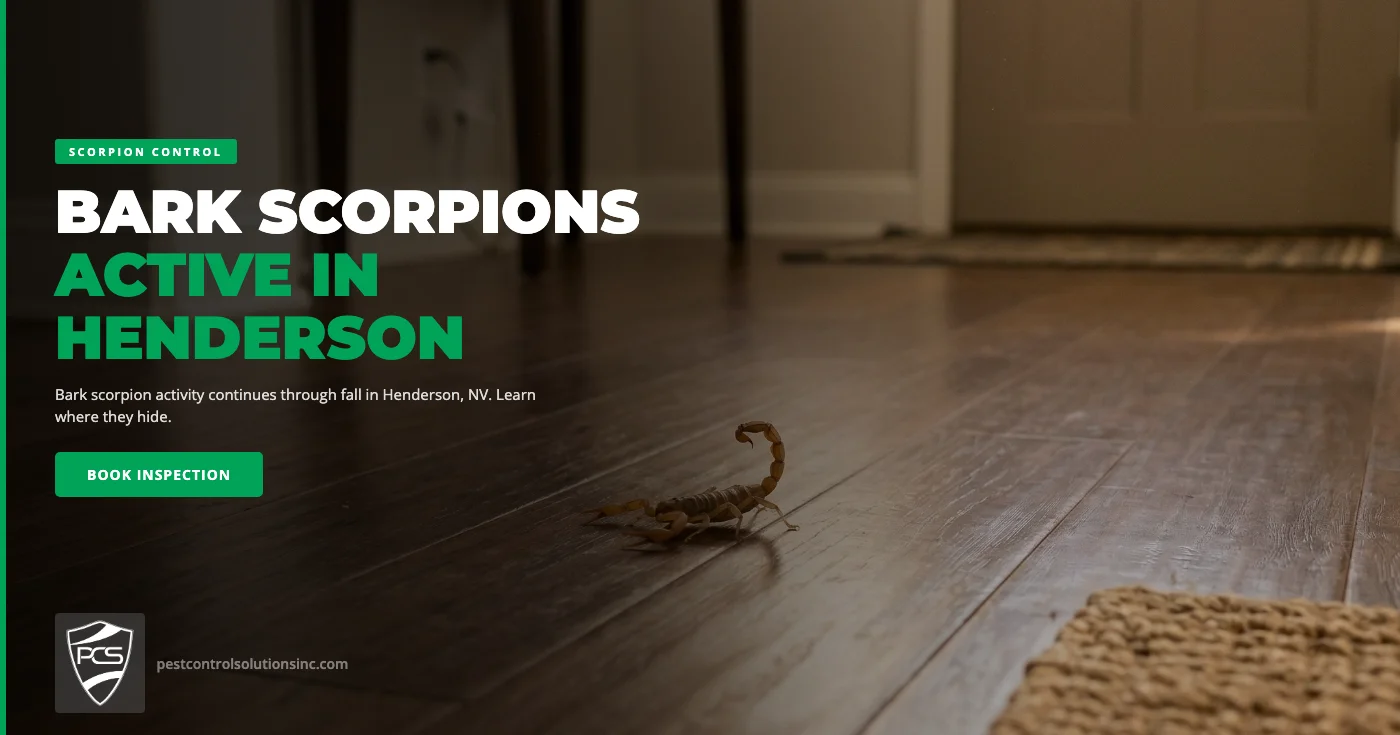
By late September in Henderson, the valley overnight lows drop into the sixties for the first time — and that is exactly when our phones at Pest Control Solutions start ringing about scorpions moving indoors. Every fall we field the same call from Henderson homeowners: a bark scorpion under a bath towel, a shed exoskeleton along a block wall, a sting on a foot that hit the tile at 2 a.m. Fall does not close scorpion season in the Las Vegas valley. It concentrates it.
Our team runs scorpion control across Henderson and the surrounding valley communities, and the volume pattern we see is consistent year after year. The peak sting reports arrive in August and September, and the pressure on homes and garages continues right through the first frost. This guide walks through why scorpion control in Henderson NV is a fall-critical service, where the bark scorpion is hiding on a Henderson property in September, and what a durable prevention plan actually covers.
Why Bark Scorpions Are Still Active in Henderson, NV Through Fall
The bark scorpion (Centruroides sculpturatus) is the most medically significant scorpion in North America, and it is the species behind almost every sting call we take in the Las Vegas valley. It is nocturnal, cold-adapted for a desert species, and remains active any night the surface temperature stays above roughly 70°F. Nevada in September and October regularly meets that threshold — the valley's daytime highs still run into the nineties well into October and the overnight lows hover in the mid-sixties. From the scorpion's perspective, that is prime hunting weather.
National poison-control data shows that scorpion envenomations peak in August and September across the desert southwest, and the University of Arizona Cooperative Extension classifies the bark scorpion as a year-round active species in the Mojave and Sonoran desert corridor (Scorpions of the Desert Southwest United States, Arizona Cooperative Extension). Fall pressure on a Henderson home also has a behavioral driver: as ambient overnight temperatures start to drop, adult bark scorpions begin the search for a stable overwintering site. Groups of twenty to thirty individuals commonly overwinter together in aggregations, and the perimeter of a Henderson home — a block wall, a stucco weep, a garage seal — is exactly the kind of shelter they select.
Where Scorpions Hide in Henderson Homes and Backyards in September
Scorpion control in Henderson NV starts with knowing where to look. The bark scorpion is unique among North American scorpions in that it climbs — it never burrows, and it will scale a vertical stucco or block-wall face without effort. On a typical Henderson property, our team maps the following hotspots on almost every scorpion inspection.
Block wall interiors and cap gaps. A two-hundred-foot block-wall perimeter contains hundreds of feet of hollow core, and every mortar gap or cracked cap block gives a bark scorpion a shaded, temperature-buffered daytime hide. This is the single largest scorpion reservoir on most Henderson lots.
Rock mulch beds and desert-landscape planters. Rock beds hold heat during the day and provide countless dark crevices between stones at night. The insects the scorpions hunt — crickets, roaches, small spiders — also live in rock mulch, so a well-established rock bed becomes both harborage and pantry.
Garage thresholds and door corners. A weatherstrip that has curled or shrunk in the summer sun lets scorpions walk directly into the garage. From the garage, they climb along the block wall of the shared living-space partition and slip through utility penetrations.
Stucco weep screed openings and utility penetrations. A bark scorpion needs a gap of only about one-sixteenth of an inch to enter a house. Every plumbing or electrical penetration on an exterior wall, every weep hole below a stucco line, and every unsealed roof-tile junction is a possible entry point.
Bathroom and laundry room drain traps. Once inside a home, scorpions gravitate toward humid rooms. Fall drops the interior humidity in most Henderson houses, which drives them to drain traps, sink cabinets, and toilet flanges.
The Biggest Risk Factors That Attract Scorpions to Your Henderson Property
Not every Henderson home carries the same pressure, and identifying the amplifying factors on a specific property is where a scorpion control plan pays off. The strongest risk drivers we see on Henderson inspections are consistent from lot to lot.
Proximity to the desert edge or a drainage wash puts a home directly on a scorpion corridor — a wash is a natural highway that connects wilderness harborage to the neighborhood. Overwatered lawns and drip-irrigation lines create the moist microclimate bark scorpions prefer. Landscape lighting, especially bright white porch fixtures, pulls in the flying insects scorpions eat and concentrates prey at the perimeter. Woodpiles, stacked pavers, unused planters, and stored patio furniture all become daytime scorpion hides. Recent nearby construction — a new subdivision, a road project, a wash clearing — displaces scorpions and pushes them into surrounding developed lots for months afterward.
Newer Henderson subdivisions built along the desert margin — Green Valley, Anthem, Seven Hills — see the most compounded pressure. A home built in the last decade on a former open-desert parcel typically carries several times the fall bark scorpion pressure of an interior valley home built forty years ago.
Signs You Have a Scorpion Problem — and What to Do Next
Because bark scorpions are nocturnal and press themselves into the tightest crevices during the day, the diurnal evidence is almost always indirect. What we look for on a Henderson property inspection are the same signs a homeowner can learn to recognize.
- Nighttime UV sightings. Bark scorpions fluoresce a bright cyan-green under a 395nm UV flashlight. A five-minute UV sweep of the block wall, the garage threshold, and the exterior perimeter after dark maps hotspots faster than any other technique.
- Shed exoskeletons along block walls. Bark scorpions molt five to six times as they mature, and each shed skin looks like a translucent white husk about the size of the live animal. A cluster of shed skins in one section of a block wall is a strong indicator that a resident population has been present long enough to breed.
- Cricket activity spiking along a baseboard. Crickets are the primary prey species for bark scorpions in this region. A sudden increase in cricket sightings in the garage or laundry room usually precedes an uptick in scorpion sightings a few weeks later.
- Actual sightings in the same rooms repeatedly. One scorpion in a shoe is a random encounter. Three in the same bathroom over two weeks is a resident population that has found a stable indoor harborage.
- Stings on family members, especially children. Any confirmed sting warrants a same-week inspection. Children experience more severe reactions to bark scorpion venom than adults, and pediatric stings should be evaluated by medical personnel and followed with a professional property inspection.
Any one of these findings warrants a call. Two or more together should trigger a same-week inspection — colony pressure compounds during fall as scorpions look for overwintering shelter, and every week of delay makes the perimeter harder to reset.
Why DIY Scorpion Control Falls Short in Henderson's Desert Climate
Our team has seen every over-the-counter scorpion product on the Henderson retail shelf, and the DIY approach fails on Henderson properties for a set of consistent reasons.
Aerosol cans and consumer-grade granules do not reach the harborage that matters. The bark scorpion population lives inside block-wall cores, under decorative stone, and in weep-screed voids — and none of those are reachable with a garden-sprayer treatment. Killing the individuals a homeowner sees on the patio at midnight has no effect on the twenty-plus overwintering in the block wall three feet away.
Bark scorpions are also unusually resistant to the pyrethroid chemistry that dominates consumer products. Direct-contact kills happen, but the residual on a treated surface degrades within days under Henderson UV and does not create the long-standing barrier a retail label suggests. Treating without a matching exclusion pass also leaves every entry point open — the outside population kills the sprayed individuals, but the pressure on the home never really drops.
Effective scorpion control in Henderson NV is a combination: exclusion sealing on every gap larger than one-sixteenth of an inch, harborage reduction in the yard, exterior perimeter treatment with the right residual products, irrigation and lighting management to reduce prey insects, and a recurring service schedule because the bark scorpion population takes months to drop. That is not a weekend project.
What Professional Scorpion Treatment Covers in Henderson, NV
Every scorpion control Henderson NV service call starts with the same on-site inspection: a daytime perimeter walk to map harborage, a UV night sweep on the initial visit or first follow-up, and a documented finding sheet the homeowner keeps for reference. From there the plan runs on four tracks.
Perimeter residual treatment. We apply a professional-grade residual insecticide labeled for bark scorpions along the foundation, block-wall base, garage threshold, and exterior door frames. The product we use holds a longer residual under Henderson UV exposure than any consumer chemistry, and we schedule the return visits before the residual is expected to break down.
Targeted crack-and-crevice treatment. Block-wall cores, expansion joints, weep-screed gaps, and utility penetrations get a targeted dust or aerosol treatment that reaches into the void where the daytime population sits. This is the step that actually reduces the resident scorpion count on a property, and it is the step consumer products cannot replicate.
Exclusion recommendations. We document every gap, every cracked mortar joint, every failed weatherstrip, and every unsealed penetration our technician can see. Homeowners get an itemized exclusion list they can address themselves, and for higher-pressure properties our team can handle the exclusion work directly.
Prey-insect reduction. A perimeter that no longer feeds crickets and roaches stops feeding scorpions. Every service call includes a general-pest treatment component so the underlying prey population drops in parallel with the scorpion population.
Most Henderson customers see a noticeable drop in scorpion sightings within two to four weeks. Full elimination is not realistic in a desert environment where the surrounding landscape supplies constant new arrivals — but a well-run recurring program keeps the resident indoor population at zero and drops the perimeter pressure to the point where a homeowner rarely encounters one.
Year-Round Scorpion Prevention Plans from Pest Control Solutions
Because Henderson's climate keeps bark scorpions active in almost every month, the customers who see the best long-term results are on a recurring plan rather than one-time treatment. Our team builds every scorpion control Henderson NV plan around three cadence options.
Bi-monthly service (six visits per year). This is the plan we recommend for homes on the desert edge, homes with children, and homes with a recent sting history. Bi-monthly cadence keeps a fresh residual in place year-round and gives our technician a routine window to catch new harborage before it becomes established.
Quarterly service (four visits per year). For lower-pressure properties — established interior neighborhoods, homes that have already run a bi-monthly year and reached baseline control — quarterly service preserves the perimeter's protection without the additional visit frequency.
Fall-and-spring intensive. For customers who prefer a lower recurring cadence, our team runs an intensive twice-a-year service tied to the two highest-pressure windows: August through October for the fall overwintering push, and April through May for the spring emergence. General-pest issues in between are covered on a call-out basis.
Every recurring plan includes UV inspections on request, exclusion consultation, and a bark scorpion sighting hotline that routes directly to a technician. Fall is the single most consequential window in the Henderson scorpion year, and a bi-monthly or quarterly plan started in September usually delivers a controlled perimeter by the following summer's monsoon.
If you have seen a bark scorpion on your Henderson property, spotted shed skins along a block wall, or had a family member stung, contact Pest Control Solutions today to schedule a scorpion inspection and a fall-baseline treatment before the overwintering push accelerates.