
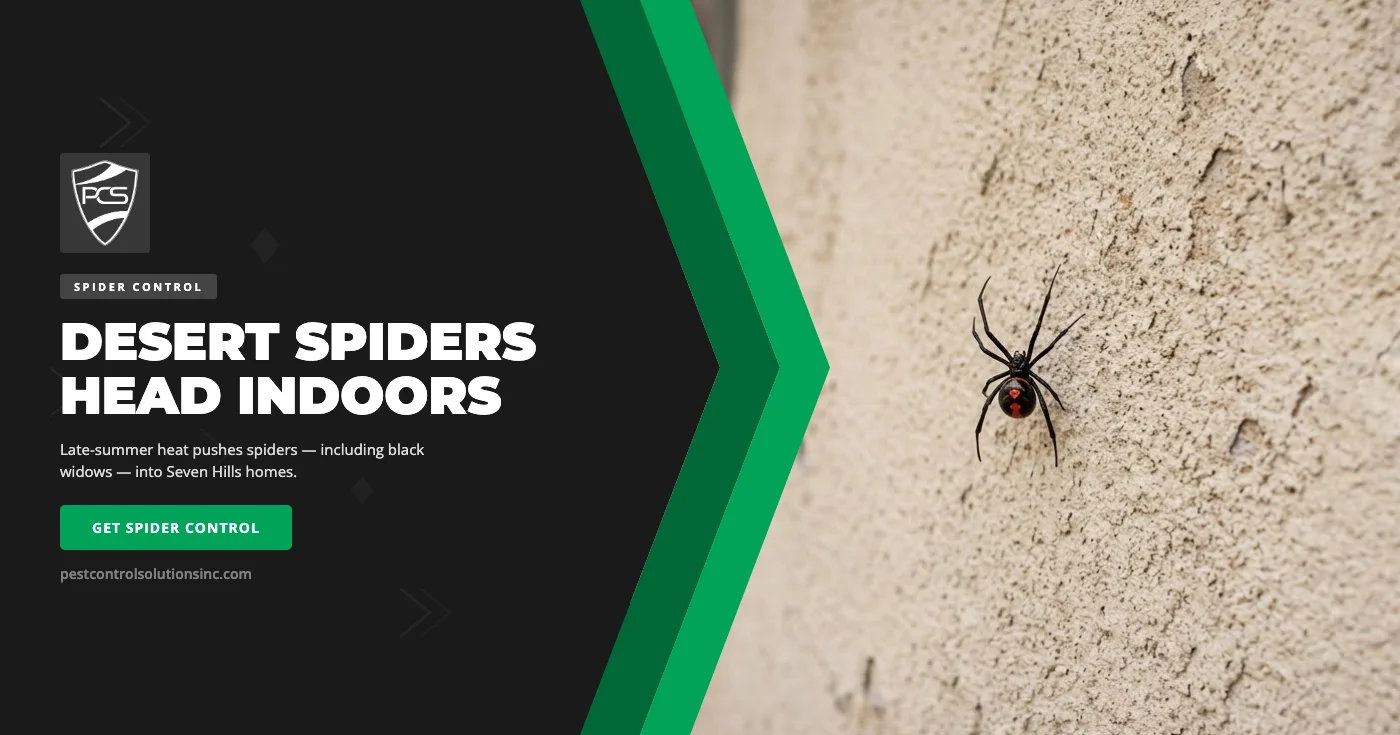
By late August, Seven Hills homeowners start finding more spiders than they did in June — in garage corners, along block walls, on door frames, and occasionally inside. That timing tracks with the late-summer conditions that make the Henderson area's spider population more visible and more active. Temperatures in the Las Vegas Valley peak between August and September, and the spiders living in desert landscapes around Seven Hills follow the same logic as their insect prey: when daytime surface temperatures exceed what's comfortable, they move toward shaded structures, cooler microclimates, and — when gaps and cracks allow — air-conditioned interiors. Spider control in Seven Hills, NV during this window focuses on reducing the harborage and entry points that turn a quiet exterior population into a garage or home problem. At Pest Control Solutions Inc, we serve Seven Hills, Henderson, and the surrounding valley through every peak spider season. Here's what drives the late-summer surge, which species to watch for, and what actually works to keep them outside.
Why Spiders Head Indoors in Seven Hills During Late Summer
Unlike scorpions or ants, spiders don't seek food inside a home — they follow insects. Late summer in Seven Hills brings a convergence of conditions that amplifies both spider numbers and their proximity to structures. Outdoor insect pressure is at its annual high after months of warm weather and irrigated landscaping. Monsoon season has added moisture to desert plants, accelerating insect reproduction. And the temperature gap between unshaded outdoor surfaces and interior spaces is at its widest — west-facing garage walls hit 140°F surface temperatures in August, and block walls along property lines radiate heat into the night, making the shaded side of any structure the most comfortable outdoor spot available.
Spiders don't tolerate core temperatures much above 100°F any better than homeowners do. They shift toward cooler microclimates — under block-wall caps, inside irrigation boxes, along door frames, and inside overhead door tracks — and as those shaded zones shrink during the hottest weeks, the gap under the garage door or the crack around an exterior utility penetration becomes appealing. Most August spider sightings inside Seven Hills garages represent this natural displacement rather than an established indoor infestation. Understanding the mechanism helps narrow the response: if the entry routes are closed and the outdoor harborage is reduced, the population that was going to push through typically stays outside.
How Desert Heat and Monsoon Moisture Drive Them Inside
Two mechanisms work in parallel to push spider activity toward structures during late summer. The first is prey concentration: July and August monsoon rains trigger a surge in flying insects — gnats, midges, moths, and other small species that gather around exterior lighting and in irrigated landscaping. More prey means more web-building activity, and that activity brings spiders closer to the lights and entry points near doors and windows. The second mechanism is population dispersal. Most desert spiders spend spring and early summer in undisturbed outdoor harborage — wood piles, block-wall gaps, dense ground cover, irrigation valve boxes. Late-summer monsoon moisture creates ideal conditions for egg sacs laid in spring to hatch, roughly doubling or tripling the total spider population visible around most Seven Hills properties within a few weeks of the first major storms.
Late-summer humidity also extends the effectiveness of spider webs. Orb webs and tangle webs that would dry and lose their stickiness in single-digit relative humidity hold longer in the 30–40% humidity that monsoon nights sometimes bring to the Henderson area. You may see more webs in August than in May for this reason — and they last longer, catching more prey per night, which keeps more spiders actively hunting near structures. The combination of higher numbers from egg sac dispersal and better hunting conditions from the humidity produces the peak visible spider pressure most Seven Hills homeowners notice between mid-July and early September.
Common Desert Spiders Found in Seven Hills Homes
Seven Hills is a master-planned Henderson community with block-wall perimeters, irrigated landscaping, stucco construction, and a combination of desert-adapted plants and turf that creates habitat for a predictable set of spider species:
- Desert recluse (Loxosceles deserta). Found throughout the Mojave, typically in dark, undisturbed spaces: block-wall crevices, storage boxes in garages, shoes left on the floor, and cardboard stacks. Tan to light brown, roughly the size of a quarter including legs, with a subtle violin-shaped marking behind the head. Non-aggressive — bites almost always result from reaching into an occupied space without checking first. Venom is necrotic and a confirmed bite warrants a call to poison control. Most "brown recluse" reports in Clark County are actually desert recluse, which is native to the Mojave.
- Wolf spider (Lycosidae). Large — up to two inches including legs — hairy, brown with striped markings, and fast-moving. Ground-hunters rather than web builders; you'll encounter them at night on garage floors, patios, and in landscaping rather than in webs. They can deliver a bite that causes local pain and swelling in some people but are not medically significant for most healthy adults. Their size accounts for most of the alarm they generate.
- Cellar spider (Pholcidae). The "daddy long-legs" spider — thin-legged, small body, messy horizontal webs in dark corners. Found in garages, laundry rooms, closets, and undisturbed interior corners. Completely harmless and actually predatory on other spider species, but web accumulation becomes a nuisance in areas left undisturbed through the summer months.
- Jumping spider (Salticidae). Small, stocky, often seen on exterior stucco walls and window screens during the day. Excellent vision, move quickly, and may jump toward perceived movement including human hands. Harmless — the most commonly startling "dangerous-looking" spider in the valley because of how they approach and move.
- Orb weaver (Araneae — multiple families). Large, colorful garden spiders most active in late summer. Build the classic wheel-spoke webs in doorways, eaves, and between plants. Common, harmless, and effective at reducing flying insect populations around irrigated landscaping. No medical concern.
Black Widows and Other Spiders to Watch For
The Western Black Widow (Latrodectus hesperus) is the only spider in Clark County with venom that causes significant systemic symptoms in healthy adults. Henderson and Seven Hills provide excellent black widow habitat: block walls, stucco cavities, irrigation valve boxes, wood piles, and dark undisturbed corners are all documented nesting environments. Black widows are slow-moving, non-aggressive, and rarely the spider a homeowner sees crawling across a floor — they build irregular tangle webs in protected, shaded spots and remain in them unless disturbed.
Identification: the female is glossy black, roughly a half-inch body length, with a bright red hourglass marking on the underside of the abdomen. Males are smaller, brownish, and not medically significant. Juveniles show orange and white markings and develop adult coloration over multiple molts throughout the growing season.
Where to look: under the rims of outdoor furniture, inside water meter boxes and irrigation valve covers, under block-wall caps, and in any undisturbed stored item in the garage — especially cardboard boxes that haven't been moved in months. The irregular web produces a distinctive crinkling sound when disturbed with a stick, which is a faster identification method than trying to spot the spider itself in a dark corner.
Bite scenarios: bites almost always occur because a person reached into a space without checking first — shoes stored in the garage, gloves in a utility closet, boxes pulled from storage, and outdoor furniture unused since spring are the four most common contact points we find during inspections. Black widow venom causes latrodectism — severe muscle cramps, pain that can radiate from the bite site to the abdomen and chest, and in some cases nausea, sweating, and elevated heart rate. Any confirmed or suspected black widow bite requires immediate medical evaluation.
Desert recluse bites are less urgent than black widow encounters in most cases, but any bite producing expanding redness, a target-shaped lesion, or blistering warrants a call to poison control regardless of whether you saw the spider responsible.
Where Spiders Hide in Your Garage, Yard, and Home
Late-summer spiders concentrate in consistent categories of harborage across Seven Hills properties. Knowing where to look makes prevention and inspection work significantly more effective:
- Block walls and cap gaps. The mortar joints and cap gaps in perimeter block walls hold heat and provide dark, protected cavities that black widows and desert recluse use year-round. The inside corner where the block wall meets the stucco of the house is a high-priority inspection point in every late-summer service visit.
- Wood piles, lumber stacks, and ground-level storage. Stacked wood and ground-contact storage hold moisture and insect prey and are nearly universal harborage for recluse, black widow, and wolf spider populations. Moving stored wood onto elevated shelving and away from the house is the single most effective harborage-reduction step most Seven Hills properties can take.
- Irrigation valve boxes and utility covers. Dark, humid, and undisturbed — the interior of valve boxes is prime black widow habitat. Any cover that is cracked, missing, or unsealed should be inspected with a flashlight before use and replaced promptly.
- Garage door tracks and overhead door mechanisms. The overhead door track runs along the wall, collects dust and debris, and stays undisturbed for months at a time. Black widow webs in door tracks are among the most consistent findings during Henderson-area garage inspections.
- Interior garage corners and wall-ceiling junctions. Cellar spiders and orb weavers build in undisturbed interior corners. The wall-ceiling junction above the door from the garage into the house is a reliable inspection point.
- Door frames, weatherstripping gaps, and utility penetrations. Small gaps around exterior door frames, window screen tears, and utility conduit passing through exterior stucco walls are the routes spiders use to move from the perimeter into living areas. These entry points become more important as outdoor temperatures peak and interior cooled air pulls spiders toward the structure.
Prevention Steps for Seven Hills Homeowners
Most late-summer spider problems in Seven Hills can be significantly reduced with targeted yard and garage work:
- Close entry points at doors and walls. Walk every exterior door frame, utility penetration, and expansion joint looking for gaps. Weatherstripping that doesn't seal at the corners, utility conduit without foam sealant, and intact but unsealed weep holes are the most common findings. Foam sealant, caulk, and replacement weatherstripping close most of what's homeowner-accessible before peak season.
- Eliminate harborage within 10 feet of the house. Move or elevate wood piles, move stored lumber off the ground onto shelving, and replace cardboard storage boxes with sealed plastic bins. Cardboard is the single most effective spider harborage material we remove from garages during late-summer pest-pressure calls — recluse in particular use corrugated channels for both shelter and egg-laying.
- Inspect and clear irrigation valve boxes and utility covers. Check every valve cover with a flashlight before reaching in. Replace cracked or missing covers — most are standard sizes and cost only a few dollars.
- Reduce exterior lighting pressure. Warm-color or amber LED fixtures attract significantly fewer flying insects than cool-white or blue-white bulbs. Fewer insects near exterior lighting means fewer web-building spiders near entry points within a few weeks of the bulb swap.
- Manage vegetation contact with the house. Trim shrubs and ground cover a foot off the exterior wall, clean dead fronds from palm trees near the roofline, and pull any ground cover contacting the foundation. The vegetation-to-stucco contact zone is where most block-wall-to-interior spider movement originates during peak season.
- Shake out stored items in the garage. Gloves, shoes, gardening gear, and seasonal clothing stored in the garage should be shaken out before use or moved to sealed containers. The habit prevents most non-aggressive spider bites, which occur almost exclusively when a person reaches into undisturbed storage without checking first.
When to Call Pest Control Solutions for Spider Control
The right time to call is when you're finding black widow webs in multiple spots around the property — not just one isolated web in the back corner of the garage — or when recluse or black widows are appearing inside the living area on consecutive days. Occasional cellar spiders in garage corners and orb weavers on the back porch are normal for a late-summer desert neighborhood and usually don't require professional treatment. The pattern that warrants a service call is recurring interior sightings of medically significant species, egg sacs found in the garage or storage areas, or a visibly dense outdoor population on block walls or in ground cover within a few feet of the house. Our spider control in Seven Hills addresses the harborage and entry points that keep the pressure going:
- Full perimeter harborage inspection — block-wall caps and interior gap probing, irrigation valve box interior check, overhead door track inspection, wood-pile and ground-storage assessment, and dense vegetation adjacent to the structure, with a written summary of all findings
- Targeted dust application in voids and protected cavities — applied to block-wall crevices, door-frame voids, overhead track channels, and other undisturbed harborage points where desert recluse and black widows establish and shelter
- Residual treatment at foundation and entry-point lines — applied at door-frame bases, weep holes, expansion joints, and utility penetrations to intercept spiders moving from perimeter harborage toward structure entry
- Web removal and egg sac elimination — physical removal forces spiders into treated surfaces when they rebuild and removes the next generation before it disperses into new harborage
- Entry-point documentation — gaps, weatherstripping failures, and utility penetrations identified and categorized as homeowner-accessible versus contractor scope
If the spider inspection turns up scorpion activity along the block-wall line, rodent evidence in the garage, or ant pressure in the irrigation zone, we can roll all of that into the same visit through our Pest Control Solutions residential program. We serve Seven Hills, Henderson, Green Valley, Anthem, Southern Highlands, and the surrounding southern valley.
Frequently Asked Questions
Why am I seeing more spiders in my Seven Hills home in late summer?
Late-summer heat pushes spiders toward shaded structures and cooler interiors, while monsoon season increases insect prey activity and triggers dispersal from spring egg sacs. August typically produces the highest spider visibility of the year in Henderson-area homes and garages.
Are black widows common in Seven Hills, NV?
Yes. The Western Black Widow is native to the Mojave Desert and reliably present in Seven Hills neighborhoods with block-wall perimeters, irrigation valve boxes, and stored items. Most properties have at least a few individuals in undisturbed outdoor harborage — the goal of prevention and treatment is keeping them from establishing in garages and living areas.
What is the most dangerous spider in the Las Vegas Valley?
The Western Black Widow (Latrodectus hesperus) is the only spider in Clark County with venom that causes significant systemic reactions in healthy adults. The desert recluse (Loxosceles deserta) produces a slow-healing necrotic wound, though serious complications are uncommon. Wolf spiders, jumping spiders, cellar spiders, and orb weavers are not medically significant for most people.
How do I keep black widows out of my garage?
Inspect and clear every undisturbed harborage point — overhead door tracks, block-wall caps, stored cardboard boxes, and irrigation valve covers — at least twice during late summer. Check before reaching into anything stored in the garage. A professional perimeter treatment significantly reduces the resident population between manual inspections.
Does one spider treatment last all season in Seven Hills?
A single treatment reduces the immediate population but does not provide full-season protection. Black widows and desert recluse repopulate from adjacent undeveloped desert and neighboring yards throughout the summer. Most Seven Hills properties with ongoing spider pressure do best on a quarterly or bi-monthly service schedule through the late-summer peak.
Get Ahead of Peak Spider Season in Seven Hills
The window that actually protects a Seven Hills home from late-summer spider problems is July and early August — before peak population dispersal and before the interior pressure builds. By the time black widows are appearing regularly in the garage, the harborage has had weeks to establish. The homeowners who make it through August without an interior spider problem seal the entry points early, clear the yard-side harborage before peak season, and get a perimeter treatment scheduled before the hottest weeks concentrate spider populations toward structures. If you're already past that point and finding black widows at multiple spots around the property or recluse inside the living area, Pest Control Solutions Inc serves Seven Hills, Henderson, Green Valley, Anthem, and the surrounding southern valley. Get a treatment on the calendar before peak season winds down.