
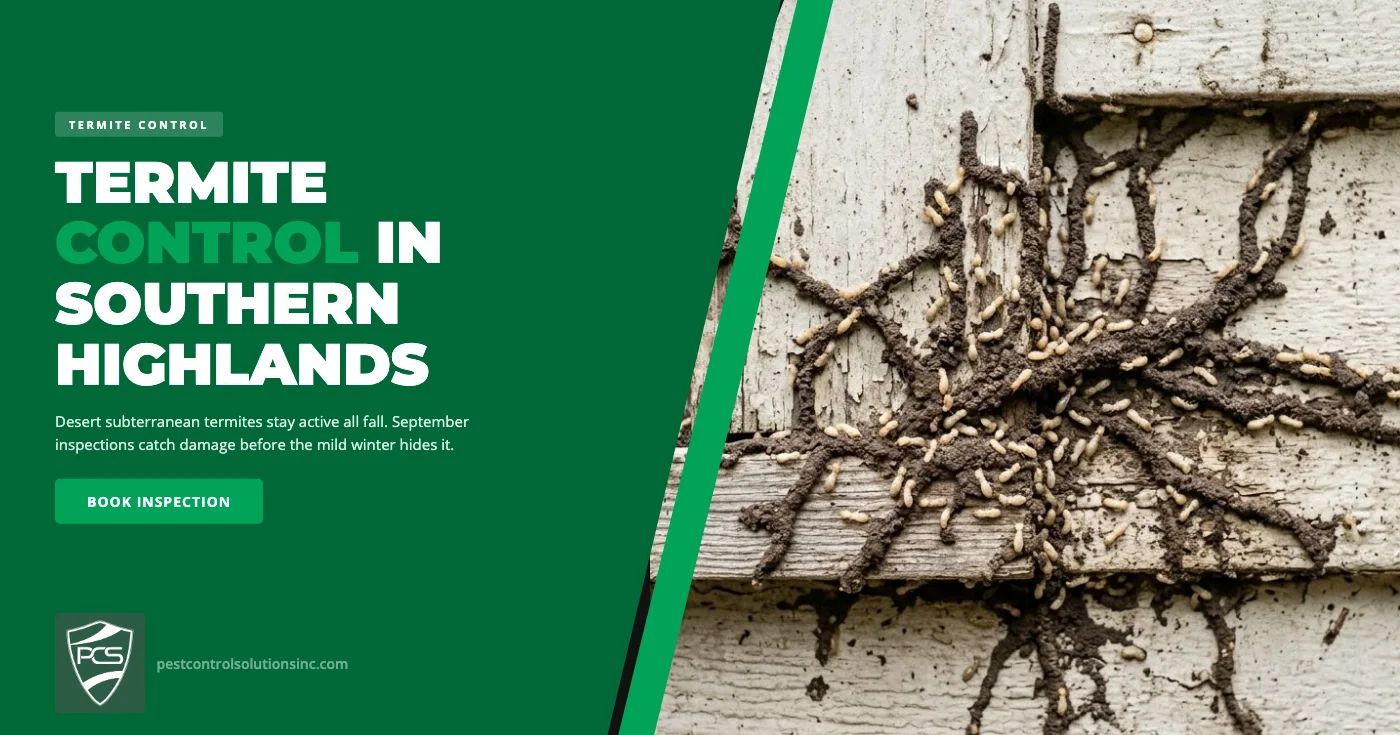
Every September the same call pattern starts across Southern Highlands — homeowners noticing thin mud lines running up a stucco wall, a paint bubble inside a garage jamb, or translucent wings under a hallway window after a warm evening. Termite control in Southern Highlands, NV is a fall specialty for our team at Pest Control Solutions because the tail of monsoon season is when subterranean colonies do their last big push before the mild desert winter — and when the damage they caused all summer finally becomes visible.
We run termite control in Southern Highlands, NV alongside Anthem, Seven Hills, and Mountains Edge every week. Desert subterraneans are active year-round because irrigation, drip lines, and pool equipment keep the soil under residential lots damp enough for a colony to forage no matter what the calendar says. Fall is the last practical inspection point before the wet weather is gone.
Are Termites Still Active in Las Vegas in September?
Yes. Desert subterranean termites in the Las Vegas Valley are active every month, and September is a peak month for foraging and swarming. Ground temperatures in Southern Highlands soil sit in a 70–85°F band six inches down, inside the ideal foraging window for Heterotermes aureus, the desert subterranean species that dominates the valley. Once monsoon moisture settles in, colonies expand foraging galleries fast — the University of Arizona Cooperative Extension has documented individual colonies extending galleries more than 100 linear feet from the nest (Termite Management for Homeowners, University of Arizona).
September also brings a second, smaller swarm. The desert subterranean species produces daylight swarms in spring and again in early fall after warm days following a rainfall event. A swarm of small tan-winged insects around a driveway, patio, or window screen on a mid-September afternoon is almost always Heterotermes aureus — and it means an established colony is on the property or an immediate neighbor's. The most efficient time to interrupt a young colony is the six-to-eight-week window between the last monsoon rain and the first cold night.
Top Signs of Termite Damage Southern Highlands Homeowners Often Miss
The obvious signs — a wing pile on the sill or a mud tube climbing the exterior wall — are the ones we get called for. The subtler signs let a colony work a home for one or two years before anyone notices.
- Blistered or dimpled interior paint on baseboards or door jambs. Subterranean termites eat wood from the inside out and leave a thin veneer of paint over hollowed framing.
- Doors and windows that suddenly stick. Southern Highlands homes ride on post-tension slabs that barely move seasonally, so a door that goes from smooth to sticking without a weather event usually means the frame is weakening from inside.
- Faint mud lines inside the garage. Termites build shelter tubes up the inside of a garage frame where they are hidden from sun and predators. A hairline mud thread behind a stored bin is often the first indoor evidence.
- Discarded wings behind cellular blinds or in window tracks. Translucent tan wings a quarter inch long, all uniform in size, are termite alates shed after a swarm.
- Frass — tiny pellets that look like coarse sand — near baseboards. More common with drywood termites, but any pellet accumulation under a wood surface warrants a professional look.
- Buckling or bubbling in laminate or engineered floors. UC IPM notes subterranean species tunnel through wood beneath the surface, and floor buckling is a common late-stage sign when the subfloor is compromised (Subterranean and Other Termites, UC IPM).
None of these signs on its own guarantees termites — moisture damage and construction settling can look similar. What they do guarantee is that a professional needs to look at the framing behind the finish.
Why Southern Highlands Homes Are Particularly Vulnerable to Termites
Southern Highlands was built out over the last twenty-five years on lots that were once undeveloped alluvial fan. That construction history creates conditions termites exploit that older Vegas neighborhoods do not share.
Slab-on-grade construction with wood frame above. Almost every home sits directly on a concrete slab with wood plates and studs rising off it. Any expansion joint, plumbing penetration, or hairline crack is a direct path from termite-friendly soil to structural wood — and desert subterraneans are opportunistic climbers that find those cracks on their own.
Heavy landscape irrigation. HOA landscaping and residential drip systems keep planter beds, tree wells, and perimeter strips lightly damp year-round. That maintained moisture is the single biggest reason termites thrive in a climate that should otherwise be too dry for them.
Wood-to-soil contact around fences and pergolas. Decorative pergolas, wood fence posts, and raised planter borders put wood in direct contact with soil. Every contact point is a foraging invitation.
Proximity to open desert. The southern and western edges of the community back up to BLM desert where native subterranean colonies have always existed. Once irrigation reaches those wild colonies, they expand toward the reliable moisture — which is why edge lots see the highest early pressure.
What a Professional Termite Inspection Covers
A proper termite inspection is a systematic walk from soil to attic, not a five-minute glance around the exterior. When our team runs termite control in Southern Highlands, NV, every inspection follows the same checklist regardless of whether a swarm has been reported.
The exterior walk starts at the foundation. We look for mud tubes on the slab edge, examine every plumbing and gas penetration, probe any wood that reaches soil, and check the pool equipment pad — a common early nesting site because of the reliable moisture. We follow every fence line and pergola post and inspect exterior wood trim within a few feet of the ground.
Inside, we move through the garage, kitchen, and any bathrooms with fixtures on exterior walls. We probe baseboards, door frames, and window trim, take moisture readings where framing meets tile or grout, and pull a scope camera into wall cavities where a soft-sounding thump warrants a closer look. The attic gets a full walk because heat-driven moisture buildup during monsoon season pushes some colonies upward. Every inspection ends with a written report showing every finding, the exact location of any activity, and a treatment plan scoped to the property.
Subterranean vs. Drywood Termites: Which Are Found in Southern Highlands?
Subterranean termites are by far the dominant threat in Southern Highlands, and the desert subterranean species Heterotermes aureus is the one we treat most often. It nests in soil, forages up through slab cracks or shelter tubes, and depends on soil moisture to survive. Colonies are typically smaller than Eastern subterranean species — a few thousand to a few tens of thousands of workers — but they are aggressive foragers and operate in conditions most termite species cannot.
A smaller share of termite control calls involve arid-land subterraneans in the genus Reticulitermes, which nest deeper and are more common along irrigated foundation lines than under open desert lots.
Drywood termites are less common here but do turn up, usually inside imported wood furniture, antique picture frames, or reclaimed lumber from a wetter region. Drywoods live entirely inside the wood they eat — no soil contact needed — and their giveaway is small piles of hexagonal fecal pellets under an infested piece. Drywood infestations are usually localized to one item or room and are treated differently from a soil-based subterranean job.
How Pest Control Solutions Eliminates Termite Colonies in Las Vegas
Our team runs termite control in Southern Highlands, NV the same way every time. Every project starts with the full property inspection above, and the treatment plan is built around what the inspection finds — not a blanket approach applied to every home.
For active subterranean colonies, we build a continuous liquid termiticide barrier around the foundation using non-repellent chemistry. The trench is cut to a consistent depth against the slab, product goes in at label rate, and the backfill is compacted so the barrier stays intact through irrigation cycles. Non-repellent products matter in the desert because termites cannot detect them — foragers pass through the treated zone, carry the active ingredient back to the colony, and the entire nest is affected within weeks.
Where slab or landscape design makes a full trench impractical, we install in-ground bait stations around the foundation and secondary structures. Stations are inspected on a scheduled rotation and monitored for the life of the service agreement. For drywood spot infestations, we treat the wood member directly with a borate-based formulation and, for larger cases, coordinate localized fumigation. Every treatment pairs with moisture-source correction so the attractant is addressed alongside the colony.
Fall Prevention Steps to Stop Termites from Overwintering in Your Home
The mild Southern Highlands winter does not knock a termite colony out. What actually reduces overwintering pressure is closing the moisture and access points the foragers use to stage inside a structure.
- Walk the drip system and repair any leaking emitters. One dripping emitter on the south side of the foundation is enough to sustain a small foraging colony through the winter.
- Pull mulch and decorative rock back at least four inches from the stucco line. Material piled against stucco hides the slab edge and gives a shelter tube a place to build unseen.
- Store firewood, lumber scraps, and cardboard off the ground and away from the house. Stacking firewood directly against a garage wall creates an invitation.
- Seal foundation cracks, slab expansion joints, and plumbing penetrations. A polyurethane sealant closes the direct-access pathways termites prefer.
- Schedule an annual inspection before the first cold night. A short inspection in October or early November catches activity that developed during monsoon season and gives time to treat before the colony overwinters intact.
Homes that pair prevention with an active termite service almost never see structural damage. Homes that skip both usually see a repair bill between the second and fourth year of colony activity.
Frequently Asked Questions About Termite Control in Southern Highlands, NV
How do I tell mud tubes apart from ordinary dirt or spider webbing?
Termite shelter tubes are made of soil, saliva, and frass compacted into a smooth, thumbnail-wide tube that runs vertically on a foundation or wall. Break a fresh tube open with a screwdriver — pale-bodied workers inside mean an active colony. Old dry tubes still mean termites were present recently.
How much damage can a colony do in a year?
A mature desert subterranean colony can consume enough framing in a single year to compromise a load-bearing header, and structural repair on a post-tension slab home often runs into the tens of thousands. Early detection is the far less expensive path.
Do I need annual termite control service or just an inspection?
For most Southern Highlands homes with drip irrigation, we recommend at least an annual inspection paired with the prevention steps above. Homes with prior activity, backyard pergolas, or lots that back up to open desert usually benefit from a monitored bait-station program on top of the annual inspection.
Are the termiticides you use gentle around pets and kids?
Modern non-repellent termiticides are applied below grade or into sealed bait stations, and the labeled re-entry period is short. Our team walks every homeowner through the product used, the treatment zones, and the timing before any application begins.
What should I do if I see winged termites this fall?
Collect a few of the winged insects or shed wings in a plastic bag, photograph the location, and call for an inspection the same day if possible. A single swarm event is a strong indicator of a nearby colony and gives our team a specific starting point.
Fall is the last practical window to interrupt a colony before it overwinters intact. Whether you see wings on the windowsill, mud lines on the garage, or a lot on the edge of open desert, contact Pest Control Solutions today to schedule termite control in Southern Highlands, NV before the first cold night.