
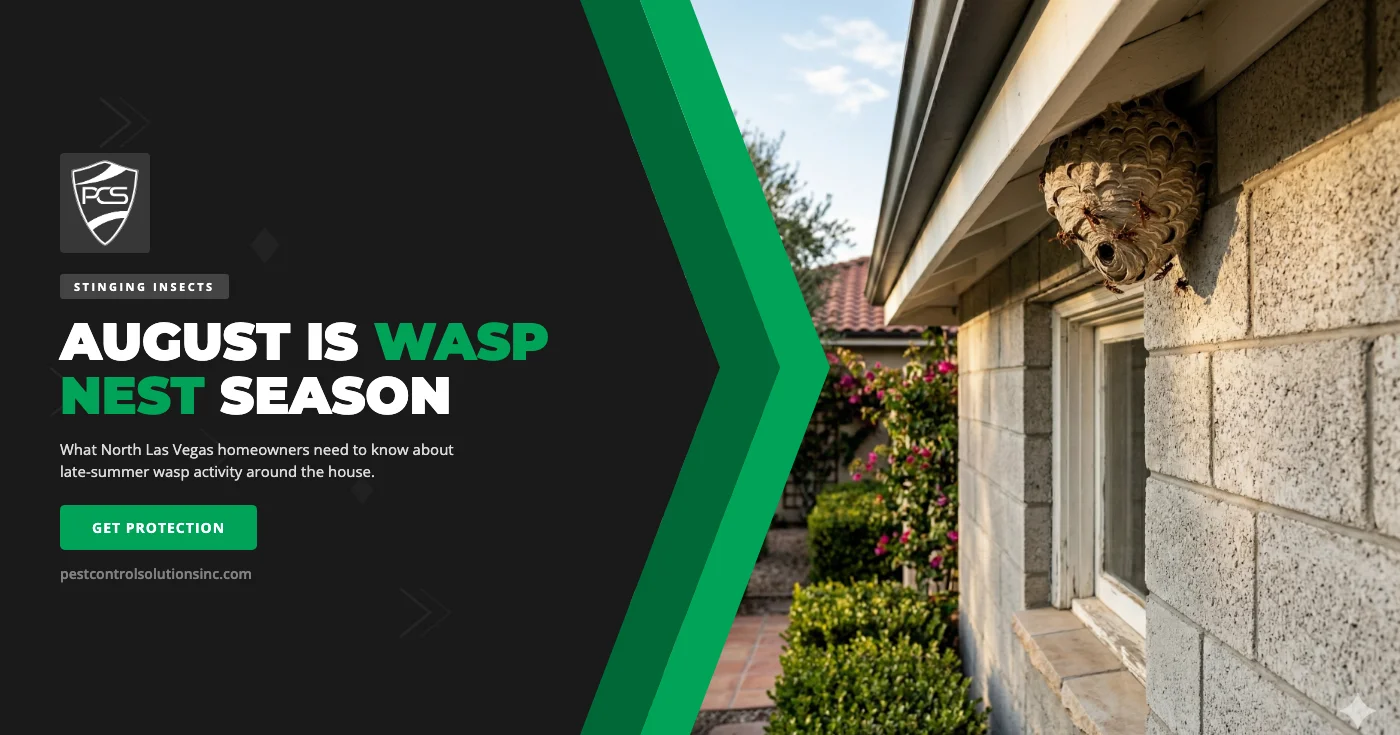
Every August the phones at Pest Control Solutions light up with the same call from across North Las Vegas — a nest under the eave that "wasn't there last week," yellow jackets swarming a pool deck, or a papery gray ball hanging from a mesquite branch. Wasp nest removal in North Las Vegas is a late-summer specialty for our team because August is exactly when colonies hit their peak size, aggression, and visibility.
Why Late Summer Is the Most Dangerous Time for Stinging Insects in North Las Vegas
Wasp colonies in the Las Vegas Valley follow a predictable annual cycle, and August is when everything peaks at once. A queen founds the nest alone in early spring, raises the first generation of workers through April and May, and the colony grows exponentially through the hot months. By August, a single yellow jacket nest in a wall void or ground burrow can hold several thousand workers, all patrolling the same territory their queen chose in March. Mild North Las Vegas winters kill off far fewer queens than colder regions, so each spring starts with more founding queens per acre, and irrigated landscaping gives workers a reliable water supply that produces larger late-season colonies.
August is also when the colony's food-seeking behavior shifts. Through spring and early summer, workers hunt caterpillars and other soft-bodied insects to feed the larvae. Once the queen slows egg-laying in mid-summer, workers stop delivering protein to the brood and start seeking sugar for themselves — which is exactly why wasps suddenly show up at your barbecue, hummingbird feeder, or half-full soda can in August when you never noticed them in June. That combination of maximum colony size, sugar-seeking behavior, and residents spending long evenings outdoors is why North Las Vegas sees more stinging-insect calls in August and September than in the rest of the year combined.
How to Identify a Wasp vs. Yellow Jacket vs. Hornet Nest
Not every stinging insect is the same problem, and the right removal approach depends on knowing what you are actually dealing with. Three groups drive most of the calls we take in North Las Vegas.
Paper wasps are the most common. They are slender, brown-and-yellow, with a thin waist and long legs that dangle in flight. Their nests are the classic open umbrella of hexagonal cells — a single flat disc of gray paper attached by a short stem, with the cells fully visible from below. Look for them under eaves, on porch ceilings, inside patio-cover framing, and behind house numbers. A typical colony peaks around 100 workers and is the least aggressive of the three groups.
Yellow jackets cause the most problems in August. They are stockier and shorter than paper wasps, brightly banded in black and yellow, and they fly with their legs tucked close to the body. Their nests are enclosed in a paper envelope you rarely see intact — western yellow jackets prefer to nest underground in abandoned rodent burrows or hidden inside wall voids, attic spaces, and outdoor equipment. What you usually see is a stream of workers flying in and out of a hole in the ground, a weep hole in a block wall, or a gap in a soffit. A mature nest can hold several thousand workers.
Hornets in our region are almost always bald-faced hornets — larger than yellow jackets, black with white markings on the face and abdomen, and unmistakable because of the nest. Bald-faced hornet nests are the large, gray, football-shaped paper structures that hang from tree branches, gutters, or the sides of buildings, sometimes reaching the size of a basketball by August. They are highly defensive within about ten feet of the nest and will pursue an intruder farther than paper wasps or yellow jackets will.
Where Wasps Build Nests in North Las Vegas Homes and Yards
After years of stinging insect calls across the North Las Vegas corridor — from Aliante and Centennial Hills through the Craig Ranch and Nellis AFB area — we can predict with high accuracy where a nest will be. A handful of locations account for the majority of our removals.
Under eaves and soffits. The single most common location for paper wasps. The overhang creates shade, protects the nest from monsoon rains, and puts the colony out of reach of most predators. A nest the size of a golf ball in June is a full-size disc by mid-August.
Patio covers, pergolas, and shade sails. The enclosed corners of aluminum patio-cover framing are prime paper-wasp real estate. Homeowners often only discover the nest when they finally hose off the patio before a Labor Day gathering and get chased back inside.
Ground burrows and block-wall cavities. Yellow jackets exploit abandoned rodent tunnels, ground squirrel holes, and the hollow cores above block-wall weep holes. Running a mower over a lawn nest can trigger dozens of stings in seconds; wasps flying in and out of a weep hole are a strong sign of an interior colony that will not be reached with over-the-counter spray.
Attic vents, soffit vents, and roof penetrations. Any opening larger than about a quarter inch is a candidate for yellow jacket entry into a wall void, where the colony expands into insulation and grows much larger than an outdoor nest would. Backyard sheds, playhouses, and BBQ islands qualify too — rarely opened, dark, and enclosed, exactly what a queen looks for in April.
DIY Nest Removal: What Works and What Makes It Worse
Every hardware store in Las Vegas stocks aerosol wasp sprays that promise a twenty-foot jet, and for a small, visible paper wasp nest early in the season, careful DIY treatment is a reasonable option. Wait until after sunset when workers are back at the nest and less active, wear closed shoes and long sleeves, spray from an angle that keeps you outside the direct flight path, and be ready to walk — not run — away. Never spray a nest from directly below, and never attempt DIY on a nest above head height where a startled swarm has a downward flight path onto you.
What makes the problem worse is DIY on a yellow jacket colony inside a wall void or a bald-faced hornet nest larger than a softball. The spray never reaches the deep nest, surface workers pour out of every exit, and the colony often relocates within days. Sealing the entry hole of a wall-void colony is the single worst move — trapped workers chew through drywall and end up in the ceiling of the room below.
Fire is not a removal method — we have inspected fascia damage from homeowners burning nests with propane torches. Water hoses just produce angry, wet, disoriented wasps who will still sting. Roughly three percent of adults have a serious allergic reaction to wasp venom, and many who react severely have no prior history, so DIY on a large or hidden colony without an EpiPen nearby and someone else present is not worth the risk.
When to Call a Professional Stinging Insect Exterminator
We recommend calling a professional in any of the following situations, and we handle these calls year-round across the North Las Vegas service area.
The nest is inside a wall, attic, or ground cavity. These infestations cannot be resolved with retail aerosol and almost always require dust formulations applied through specialized equipment at the correct entry point.
The nest is larger than a softball or above ground-floor reach. Bald-faced hornet nests and mature colonies contain far more workers than a single spray can neutralize. Second-story eaves and tall trees also mean working from a ladder while wasps are actively defending — the sting risk and the fall risk combine badly.
Anyone on the property has a known sting allergy, or stings have already happened. The consequence of a wrong-guess DIY attempt is not worth it for a household member who carries an EpiPen, and a colony that has already stung once is defensive and will not de-escalate on its own.
Our bee and wasp control service uses commercial-grade dust and residual formulations, extension tools that keep the technician outside the defensive radius, and confirmed follow-up so the colony does not rebuild in the same location. Same-day service is available for active stinging emergencies during summer months.
How to Prevent Wasps from Returning Next Season
Once the current nest is neutralized, prevention becomes a spring project. The single most effective time to interrupt the wasp cycle is April, when founding queens are scouting for nest sites but have not committed to one.
Inspect the property in early April. Walk the exterior with binoculars, looking at every soffit corner, patio-cover joint, playhouse ceiling, and outdoor light fixture. Any small starter nest — often just a stem with three or four cells and a single queen — should be knocked down while the colony is still one insect. Remove the paper stem completely; a partial removal is often rebuilt in the same spot.
Seal openings before spring. Attic vents, soffit vents, weep holes at the base of block walls, and gaps around utility penetrations should be screened with quarter-inch hardware cloth. Interior wall cavity nests almost always start with a queen entering through a gap smaller than a dime.
Reduce standing water and sugar sources. Emptying pet water bowls at night, covering trash cans, cleaning up fallen fruit from ornamental citrus and mulberry, and pulling hummingbird feeders in during August dramatically reduces the pressure that brings wasps into human spaces during peak season.
Fill abandoned rodent burrows and schedule preventive service. Any hole in the yard from ground squirrels or previous rat activity is a candidate site for yellow jacket colonization next spring — fill burrows with soil and gravel as you find them. Our quarterly maintenance customers also get a spring exterior treatment that deters queens from starting nests on the structure, and those homes call for wasp emergencies at roughly one-tenth the rate of homes without one.
Frequently Asked Questions About Wasp Nest Removal in North Las Vegas
Will the wasps come back to the same spot after the nest is removed?
New queens the following spring often prospect previously successful nest sites because the pheromone traces linger. Complete physical removal of the paper structure combined with a residual treatment at the location significantly reduces the odds of rebuilding.
Is it worth waiting for winter to kill the wasps naturally?
Not in North Las Vegas. Mild winters do not reliably kill enclosed colonies, and even nests that do die off remain hazardous through August and September — that is when the peak population is out foraging and defending. Waiting six weeks in an active August colony is six weeks of ongoing sting risk.
Can I use peppermint oil or fake nest deterrents to keep wasps away?
These home remedies have limited effect on established colonies. Fake paper-bag "hornet decoys" work only against queens still scouting in early spring; they do nothing to a nest already in place. Peppermint oil and other essential-oil sprays can briefly deter individual foragers but do not remove or prevent a colony.
What should I do if I have been stung and I am not sure if I am allergic?
Wash the sting area, apply a cold compress, and take an oral antihistamine. Watch for hives spreading beyond the sting site, swelling in the face or throat, difficulty breathing, or lightheadedness — any of these symptoms means calling 911 immediately. A single sting in someone with no prior allergy history is not usually an emergency, but a first-time severe reaction is possible and worth taking seriously.
August brings the numbers, the aggression, and the sugar-seeking behavior that puts wasps in direct conflict with your outdoor spaces. Whether you have a paper wasp nest under an eave, yellow jackets flying in and out of a block wall, or a hornet nest hanging from a mesquite, contact Pest Control Solutions today — our team provides same-day bee and wasp control across North Las Vegas.